




Jerky beef, dried meat strips
The Beef jerky is lean beef that has been marinated and then dried until you have tasty, dry strips with that characteristic firm texture.
Making it at home using a food dehydrator allows you to choose the meat, spices and marinade yourself, tailoring the result to your own tastes.
In this recipe, we’ll see what type of meat to use, how to cut and marinate it, and how long to dry the beef jerky with Biosec.
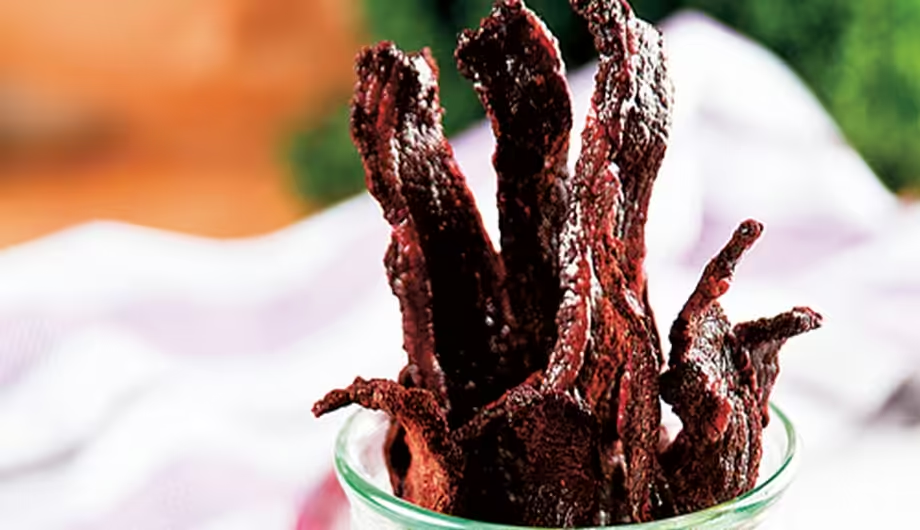
Meat requires a bit more attention than fruit and vegetables: if you’d like to find out more about the appliance’s features, temperature and airflow, you can also read our guide on How to choose a meat dryer.
Which cut of meat should you choose for beef jerky?
To make good beef jerky, choose very lean beef.
Fat must be removed as much as possible because, unlike lean meat, it does not dry out properly and can compromise the quality and shelf life of the final product.
A brief spell in the freezer can make the meat firmer, making it easier to slice thinly and evenly.
Ingredients
-
800 g of very lean beef
-
65 ml Worcestershire sauce
-
65 ml soy sauce
-
1 tablespoon tomato juice
-
1 tablespoon white wine vinegar
-
1 teaspoon sugar
-
¼ teaspoon of garlic powder
-
¼ teaspoon of onion powder
-
1 teaspoon salt
Procedure
Removed from the meat all visible fat.
If necessary, leave it to cool briefly in the freezer until it is firm enough to be cut neatly.
So work out thin strips about 3 mm wide, trying to keep the thickness as even as possible. A consistent cut is important because it ensures that the different strips dry in a similar amount of time.
Prepare the marinade by mixing together Worcestershire sauce, soya sauce, tomato juice, vinegar, sugar, garlic, onion and salt.
Place the meat in a container, spread the marinade evenly over it and leave it to rest in the fridge overnight.
Once the marinating is complete, drain the strips and arrange them on the dehydrator trays without overlapping them, allowing air to circulate freely. In the ours Biosec domestic dehumidifiers, the horizontal airflow passes evenly through the baskets during the drying process.
An important note on safety
When making dried meat at home, the air temperature in the dehydrator does not necessarily correspond to the temperature reached inside the meat.
When making beef jerky, it is therefore important to follow the correct procedure, including from a health and hygiene perspective, and to use a food thermometer to check that the meat has reached the required internal temperature before drying.
Drying programme and time
With Biosec, you can use P4 SuperHot, the programme designed for dishes that require higher temperatures.
You can find out more about how it works and its features in the guide to Biosec drying programmes.
Arrange the strips on the trays and start the drying process.
As a guide, work out approximately 4 hours to start with, then turn the strips over and continue cooking, checking them from time to time. Depending on the thickness of the meat and the quantity being cooked, it may take a further 6–8 hours or so.
The times given are for guidance only: the thickness of the slices, the amount of water retained after marinating and the load in the dehydrator can significantly affect the drying time.
How to tell when beef jerky is ready
The finished beef jerky should be:
-
dry on the surface;
-
darker in colour than the original meat;
-
compact and fibrous;
-
still slightly flexible.
Try folding a strip once you’ve let it cool down: it should bend and show small cracks without breaking cleanly.
If there are still visibly damp areas inside, carry on drying.
How to store beef jerky
Leave the jerky to cool completely before packing it.
For home cooking, it is advisable to store it in the fridge, in a tightly sealed or vacuum-sealed container. For longer periods, freezing is preferable.
The actual shelf life depends on the amount of residual moisture, the fat content, the preparation method and the packaging system: for this reason, I would avoid automatically assuming that homemade jerky is equivalent to a long-life commercial product.
To find out more about the general principles, you can also consult our guide on how to store dried food properly.
The result is a a rich and flavourful dried meat snack, which is convenient to prepare in advance and easy to personalise by adjusting the spices and marinade.



 Italian
  English
  German
  Spanish
  French
  Romanian