




Meat dryers: how to choose the right one
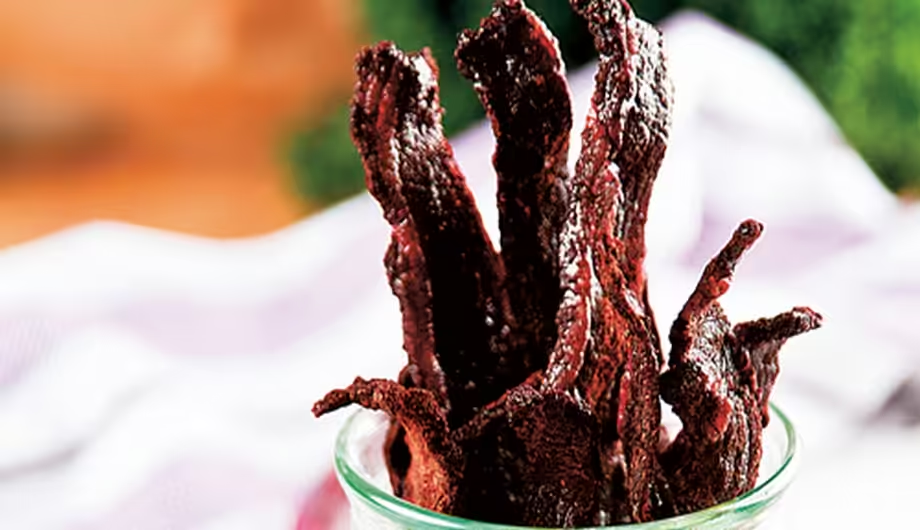
When it comes to properly made dried meat, the line between a good result and a disappointing product is narrower than it seems. All it takes is a poorly managed temperature, an uneven airflow or inconsistent thickness to compromise texture, flavour and shelf life. That is why choosing a meat dryer is not simply a matter of buying a household appliance, but of acquiring a precise, reliable tool suited to your way of working. Our artisanal tradition, rooted for over thirty years in the Veneto countryside in Camisano Vicentino, has taught us that technology must always serve the raw ingredient, enhancing its authentic character without altering it.
Meat is a delicate raw material. Unlike many vegetables, it requires technical care at every stage: cutting, marinating, arranging on the shelves, air management and time control. Those preparing small quantities at home are looking for convenience and consistency. Those working professionally, on the other hand, also need uniformity, repeatability, production capacity and food safety. In both cases, the principle remains the same: proper drying involves removing water gradually and in a controlled manner, eliminating almost all free moisture to inhibit biological spoilage processes whilst preserving the food’s organoleptic qualities, aromas and texture intact.
Why is a meat dryer different from any other?
Not all dehydrators perform in the same way when drying protein-rich foods. Meat releases moisture differently to fruit, vegetables or herbs, and requires constant air circulation across its entire surface.
This is where the quality of Tauro Essiccatori’s design comes into its own. Our exclusive horizontal airflow system, featured in both our domestic and professional ranges, distributes the air evenly and in a single direction across the shelves. The air enters at one end of the tunnel, passes through every level simultaneously and exits at the opposite end without any mixing of flavours or build-up of moisture. It makes a real difference – it’s not just a technical detail for industry insiders. When the air reaches every level effectively, the meat dries more evenly and the process becomes fully controllable, ensuring a consistent and reliable result from the first to the last tray.
Temperature stability is also crucial. A well-designed dryer must maintain the set temperature without excessive fluctuations. In meat processing, this aspect is particularly important, as the final result depends on striking a balance between gradual dehydration and preserving the product’s characteristics. Our units manage the heating cycles with extreme precision, alternating between hot air flows and ventilation periods to optimise the efficiency of the process.
How to choose a meat dryer based on actual use
The first question to ask isn’t which model to buy, but how much meat you want to dry and how often. Anyone who makes protein snacks or home-dried meat Once or twice a month, you might opt for a compact yet precise machine from the Biosec domestic range, fitted with baskets made from certified BPA-free plastic or stainless steel, both of which are conveniently dishwasher-safe. Those working with regular batches – perhaps for direct sales, a farm holiday business, a workshop or on-farm processing – need to consider capacity, operational continuity and load management.
For the more demanding professional requirements, the choice tends to fall on advanced models such as the Biosec Pro or the B.Master Base and Plus series, which offer drying surfaces ranging from three to fifty square metres. These machines are made entirely of food-grade stainless steel in accordance with the strict MOCA regulations; they feature insulated casings to reduce energy consumption and incorporate advanced Industry 4.0 technology with remote Wi-Fi control, whilst maintaining the highest standards of hygiene.
Another key criterion is ease of control. Clear programmes, reliable adjustment and intuitive operation help both beginners and those wishing to standardise their processes. When drying meat, consistency is more important than complexity. It is better to have a machine designed with logic, which guides the process consistently, rather than additional functions that are of little practical use in day-to-day operation.
Build quality is also important. Sturdy materials, ease of cleaning and reliable after-sales support make all the difference in the long run. A meat dryer is used to process foodstuffs that require strict hygiene standards and regular maintenance. This is why it is important to choose a specialist manufacturer who truly understands the drying process and does not offer generic imported solutions lacking spare parts or direct technical support.
The features that really matter
The first feature to consider is precise control of temperature and timing. There is no need to aim for extreme figures, but it is essential to be able to manage the process accurately. Every cut, every thickness and every preparation requires minor adjustments. A machine that allows for this degree of flexibility delivers more reliable results.
The second factor is the uniformity of the air flow. This is at the heart of the process. If the air does not circulate properly, even high-quality raw materials lose their value. The meat must dry evenly across its entire surface, without some areas being overexposed and others under-exposed. The horizontal, unidirectional technology ensures that evaporation occurs at the same rate across every centimetre of the shelf.
The third point concerns usable capacity, which is not simply a matter of the number of shelves. What matters is the space that can actually be utilised and the arrangement of the items so that they do not overlap. Overfilling the dryer reduces its effectiveness. Sometimes it is better to have a slightly smaller, but well-distributed, load, to allow the air the space it needs to circulate effectively around the product.
Finally, there is operational continuity. A well-designed dryer must be able to operate reliably for hours on end, without any drop in performance. Who dries meat? He knows that patience is part of the process: the result cannot be rushed, and the machine must maintain this pace. At the end of the cycle, an automatic hold function proves crucial: it maintains the product at the optimum level of dryness until packaging, preventing it from reabsorbing moisture from the surrounding environment.
Home and commercial meat drying: what’s changing
At home, the aim is often to combine flavour, home-making and control over the ingredients. Making your own dried meat at home allows you to choose the cuts, marinades and thicknesses, minimising unwanted additives and enhancing the quality of the raw ingredients through a natural and mindful method. For this, you need a dehydrator that is reliable, simple to use and easy to clean on a daily basis.
In a professional context, however, more complex factors come into play. It is necessary to consider the repeatability of results, volume management, production organisation and economic efficiency. Uneven drying leads to waste, lost time and inconsistent quality. For farms, artisan workshops, the hospitality sector and specialist pet food manufacturers, the choice of dryer has a direct impact on the value of the final product and on the ability to optimise operating costs.
This is where design expertise comes to the fore. A specialist manufacturer such as Tauro Essiccatori has been developing a drying philosophy for years that combines technology, training and practical application. This approach is particularly important for those who are not simply looking for a machine, but for a working method that is reliable, sustainable and efficient in the long term.
Common mistakes when using a meat dryer
The first mistake is to start with uneven slices. If some pieces are thin and others thicker, the drying process will not be consistent. Precision begins right from the cutting stage, where the aim must be to achieve consistent thicknesses to ensure uniform drying times.
The second mistake is overloading the shelves or stacking pieces of meat on top of one another. The raw meat needs space to allow air to circulate evenly across its entire surface. Packing the product in tightly to save time usually has the opposite effect, slowing down natural evaporation and risking the spoilage of the batch.
The third mistake is to underestimate the importance of preparing the raw material. Choosing lean cuts is an absolute must, as fat does not dry out and tends to go rancid over time, rendering the preservation process ineffective. Proper drying and neat arrangement have a direct impact on the final quality. The dryer works well if the process is set up correctly from the outset.
There is also a more subtle mistake: assuming that all food dehydrators are the same. They are not. With meat, more so than with other foods, the limitations of an unstable machine – one lacking dedicated high-temperature programmes or designed without any real specialist knowledge of airflow – become apparent.
Quality of the result: what to really expect
A good dried product must not simply be dry. It must retain a fresh aroma, a texture consistent with the chosen preparation, and a uniform appearance. Colour matters too: a well-managed drying process better preserves the characteristics of the raw material, without completely dulling its visual identity and aromatic fragrance.
Of course, the result also depends on the type of meat, the cut, the marinade and the intended use. Some people look for a softer texture for quick snacks, whilst others prefer a drier, firmer product, ideal for very long-term storage or for grinding into a powder as a natural flavouring. There is no single answer that applies to everyone, but there is one reliable criterion: a good dehydrator must enable you to reproduce the desired result consistently every time.
This is the factor that often distinguishes a successful purchase from a poor one. It is not enough simply to achieve a satisfactory result once. What matters is being able to work effectively over time, consistently, reducing waste and making the most of every single production batch using a tool built to last.
When is it really worth the investment?
A meat dryer is worth the investment when it meets a specific need: conscious home production, recovery of overproduction, expanding the range of artisan products, developing snacks with higher added value, or creating natural pet food for one’s own pets. In all these cases, the right machine is not the one that promises miracle solutions, but the one that carries out, effectively and precisely, what is really needed in day-to-day practice.
For those who work with food, this also means respecting the raw ingredients and combating food waste. Drying meat properly means transforming it without trivialising it, preserving it without losing its original organoleptic identity, and extending the food’s shelf life without straying from its very essence. It is a technical choice, but also a deeply cultural one.
When chosen with care, drying becomes a tool of superior quality rather than a mere mechanical stage in the production process. And this is precisely where a good dryer demonstrates its true value: in its ability to support day-to-day work or a domestic passion with precision, reliability and consistency, whilst allowing room for the producer’s expertise and the authentic character of the food.
The expert’s tip for perfect dehydration
To produce safe, stable and tasty dried meat, select very lean cuts, taking care to meticulously remove every trace of visible fat. Before arranging the pieces on the shelves of your dehydrator, cut them into uniform slices about three millimetres thick, holding the knife strictly perpendicular to the muscle fibres: this will ensure the final snack is pleasant and easy to chew. Start the process immediately by placing the trays in the tunnel and select the highest-temperature programme to quickly reduce the surface bacterial load. You can then continue drying until the meat is firm and dark, with no give in the centre. Remember that trimmings or small pieces should never be thrown away: once they are completely dried, you can blend them finely in a powerful food processor to obtain a smooth powder, perfect as a natural flavouring for stocks and minestrone, or as a base for a homemade, locally sourced meat stock cube.
Discover the world of Tauro Dryers
Whether your goal is mindful, tradition-linked home production, or you need to expand your professional workshop's production capacity with rigorous standardization, our horizontal flow systems represent the ideal choice for effectiveness and reliability. We invite you to explore our entire range of dehydrators Biosec e B.Master here on the Tauro Essiccatori website, where you can find technical insights, specific accessories such as reusable non-stick sheets and dedicated guides. Join our community to exchange ideas with experts and enthusiasts of natural preservation and breathe new life into your culinary creativity.
 Italian
  English
  German
  Spanish
  French
  Romanian