




Washing mushrooms before drying them: the definitive guide to safe cleaning
Should wild mushrooms be washed before drying?
Yes. Mushrooms picked in the woods must be washed thoroughly under running drinking water before being sliced and dried. If, for years, you have heard the absolute rule that “you must never wet mushrooms” repeated time and again, the time has come to set the record straight: a wild mushroom is not a sterile product. To ensure safe, hygienic and top-quality drying, the correct use of water is not only permitted but is an absolute necessity.
In culinary tradition, the advice not to wash mushrooms stems from the desire to preserve their firm texture for immediate use in a frying pan. However, when it comes to long-term preservation through dehydration, the rules change radically. Let’s get straight to the crux of the matter: a mushroom intended for drying must enter the dehydrator completely free of soil, sand, debris and contaminants. And to achieve this, a brush and a knife are often not enough.
Why wild mushrooms really do need to be washed
The reason why I strongly recommend washing them is very practical and leaves no room for romantic interpretations. A wild mushroom grows in a natural and entirely uncontrolled environment. As it develops, it may come into contact with soil, fine sand, decomposing plant matter, stagnant water or rainwater. But that’s not all: the woodland is inhabited. Mushrooms are exposed to insects, snails, wild animals and their droppings. It is humanly impossible to know with certainty what every single porcini, chanterelle or honey mushroom has come into contact with whilst growing.
In this context, washing is not a culinary quirk or a matter of personal preference: it is a basic hygiene measure prior to storage. The Codex Alimentarius and the most stringent food safety regulations are clear on this point, defining dried mushrooms as products that must be free from organic and mineral impurities. Leaving soil at the base of the stem, or grains of sand lodged between the gills or in the spongy flesh of boletes, means introducing a potentially dangerous soil-borne bacterial load into the dehydrator (and subsequently into your jars in the larder).
The first fundamental rule: drying preserves food, it does not sterilise it
A common misconception, which I would like to correct straight away, is the belief that the heat from the dryer acts as a universal disinfectant. The dryer is not an autoclave and is no substitute for ensuring the hygiene of the raw materials.
Drying works by reducing the free, available water within the food, thereby preventing the growth of mould, yeasts and most pathogenic bacteria. However, whilst removing the water stops the growth of microorganisms, it do not sterilise the product.
Bacteria that may be present in the soil of a fresh mushroom (such as Listeria monocytogenes, Salmonella spp. e Bacillus cereus) can easily survive in a dormant state in the dried mushroom for months on end. The risk will resurface as soon as the mushroom is rehydrated in the kitchen. Running water helps to drastically reduce this initial surface contamination. Furthermore, always bear in mind that drying:
- It does not eliminate toxins: It does not make a poisonous mushroom edible.
- It doesn’t work miracles: It does not collect specimens that are rotten, mouldy or heavily infested with larvae.
- It does not purify: It does not remove heavy metals or pesticides absorbed from the soil.
Always ensure that you have your harvest checked by the local Mycological Inspectorates. Only mushrooms that are healthy, clean and identified with absolute certainty should be dried.
How to clean mushrooms: a 6-step guide
Washing does not cause the mushroom to “absorb water” and does not in any way affect the drying process, provided it is carried out properly. The key is to avoid soaking at all costs. Here is the step-by-step procedure I recommend you follow:
- Sorting and dry weeding: Using a clean knife, cut off the end of the stalk (the hardest part, covered in soil) and scrape off any obvious dirt. Remove any soft or damaged parts.
- Brushing: Run a soft-bristled kitchen brush over the cap and stem to remove pine needles, leaves and most of the soil.
- Targeted rinsing: Hold the mushroom under a stream of cool, running drinking water. Wash the base of the stem, the pores, the gills, the folds and all those areas where dirt and insects can hide thoroughly. Wash them quickly and vigorously. Never leave mushrooms to soak in a bowl!
- Draining and blotting: Once rinsed, drain the mushroom thoroughly. You can do this by gently dabbing it with kitchen paper or a clean tea towel, or by using a salad spinner set to a very gentle spin.
- Hygienic cut: Slice the mushrooms to a thickness of about 4–5 millimetres. It is essential that you do this with clean hands, on a sanitised chopping board and with a washed knife, so as not to recontaminate the freshly exposed flesh.
- Instant drying: Do not leave the wet, sliced mushrooms on the table to stand. Place them in the baskets straight away and start the machine. The time between washing and the start of the drying process should be as short as possible.
The myth that water “ruins” the drying process
The classic objection I’m often faced with is: “But Livio, if I wash the mushroom, it soaks up water like a sponge and won’t dry out anymore!”. This only happens if you make the mistake of leaving it to soak. A quick rinse under the tap, followed by proper draining, adds only a slight amount of surface moisture.
A essiccatore di qualità, se non viene sovraccaricato, è perfettamente in grado di smaltire questa lieve umidità aggiuntiva nei primissimi minuti del ciclo di lavorazione. Il vero danno al fungo non lo fa l’acqua corrente, ma l’attesa prolungata a temperatura ambiente: umidità, polpa tagliata e calore ambientale innescano rapidamente l’ossidazione e il decadimento del prodotto.
Processing times, temperatures and Tauro technology
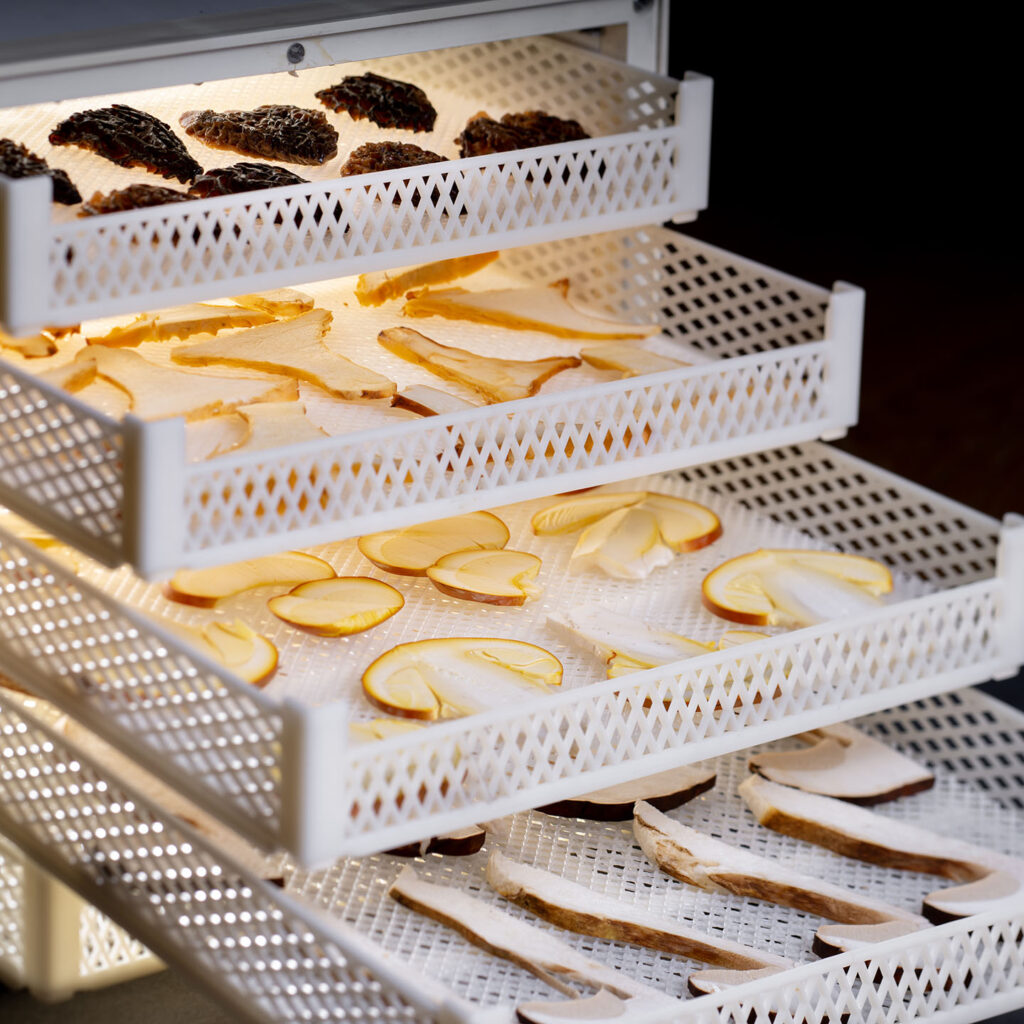
Once the slices have been arranged on the trays in a single layer (without ever overlapping them, to prevent moisture from building up), it is time to set up the machine. The ideal temperature for drying mushrooms whilst preserving their colour, aroma and cellular structure is between 45°C and 55°C.
In Tauro abbiamo progettato soluzioni specifiche per rendere questa fase infallibile, sia per chi lo fa per passione in casa, sia per i professionisti del settore alimentare:
- For domestic use: se possedete una nostra macchina, vi basterà selezionare i programmi automatici studiati appositamente. Se volete approfondire come la macchina gestisce in autonomia temperature e ventilazione, Discover the programmes on the Biosec dehydrator, in particular the P2 programme for mushrooms, or the T5 programme for precise temperature control.
- Advanced electronic management: il cuore intelligente dei nostri sistemi assicura che l’umidità estratta venga smaltita costantemente. Se siete curiosi di capire come ottimizziamo i consumi garantendo un’essiccazione perfetta, vi invito a leggere le specifiche del nostro Dryset Pro electronic system.
- Absolute uniformity: il segreto di una disidratazione omogenea, dove le fette del piano superiore seccano esattamente come quelle del piano inferiore senza mescolare gli odori, risiede nell’architettura della macchina. Non diamo nulla per scontato: scoprite i vantaggi del flusso d’aria orizzontale unidirezionale, la tecnologia che permette all’aria di lambire ogni singola fetta in modo parallelo.
- For professionals: se gestite un’azienda agricola, un agriturismo o lavorate grandi lotti di funghi per la vendita, la procedura di lavaggio diviene un obbligo normativo (Regolamento CE n. 852/2004) da inserire nel piano HACCP. Per supportare volumi importanti con la massima garanzia igienica, Explore professional solutions for laboratories and businesses.
Safe storage and reuse
Once the cycle is complete, the mushrooms should be dry, crisp or only slightly flexible, but must be completely free of any damp or soft patches when touched.
Riponeteli in vasi di vetro a chiusura ermetica, al riparo dalla luce e da fonti di calore. Quando sarà il momento di utilizzarli, basterà reidratarli in acqua tiepida per una mezz’ora. E un piccolo trucco: se i funghi erano ben puliti prima dell’essiccazione (potete esserne certi solo se li avete essiccati voi seguendo questa procedura), potete filtrate l’acqua di reidratazione con un colino a maglie strettissime ed utilizzarla in cottura, sarà un concentrato di sapore incredibile per i vostri risotti e i vostri sughi!
Conclusions
A wild mushroom should not be treated as if it were already clean: before drying it, it must be sorted, checked, washed under running water, drained and processed straight away. The dehydrator preserves a clean product; it does not turn dirt into quality.
Autore – Livio Zanon Santon
 Italian
  English
  German
  Spanish
  French
  Romanian