




Professional tumble dryers: how to choose them
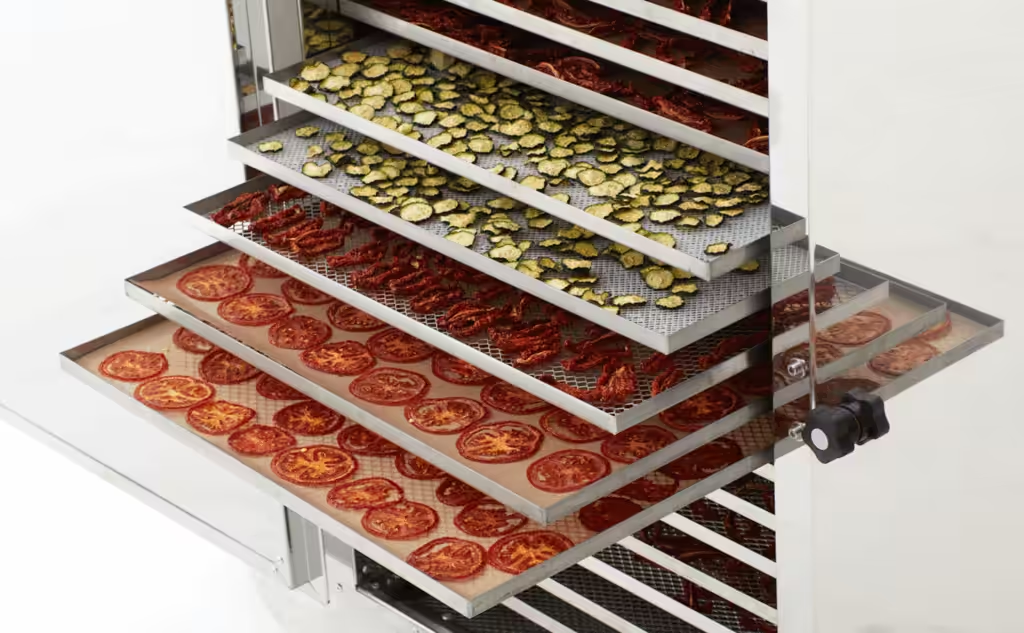
When it comes to professional dryers, the difference lies not simply in the size of the machine or its sheer capacity. It lies, much more profoundly, in the end result: absolute uniformity of drying, the preservation of the product’s organoleptic integrity, operational continuity and the practical ability to transform seasonal raw materials into a stable, fragrant and marketable food product throughout the year. For sectors Whether you run a processing plant, a farm or a business in the HoReCa sector, choosing the right drying system has a direct impact on the quality of your day-to-day work and your profit margins.
L’professional drying It should not be regarded as a mere technical step or a passive process of water removal. It is a crucial technological stage that can either preserve the food’s original quality or irreparably compromise it. The natural colour, the flavour profile, the final texture and commercial yield depend entirely on how the airflow passes through the product, on the level of electronic control of the hygrometric parameters, and on the extent to which the machine has been designed to operate consistently, eliminating at source any differences in temperature or ventilation between one shelf and another.
What are professional dryers actually used for?
In a modern, environmentally conscious production context, drying food is first and foremost about creating added value and actively combating food waste. Surplus fruit, seasonal vegetables harvested at the perfect stage of ripeness, aromatic and medicinal herbs, mushrooms, preparations for haute cuisine or ingredients for natural pet food can find a new economic use through a well-managed dehydration process. It is not just a matter of extending shelf life, but of building a commercial offering consistent with a market demand increasingly oriented towards clean foods, free from artificial preservatives and easily traceable.
For many businesses in the agri-food sector, the dryer has become an integral part of the daily workflow, serving as a strategic tool for diversification and logistical flexibility. A farm stay It can use surplus produce from its harvest to create semi-finished ingredients for its own kitchen or to package small batches of products for direct sale. An artisanal workshop can standardise its recipes and the consistency of its wafers or powders, ensuring uniformity across different production batches. A farm can absorb seasonal production peaks, turning a potential loss into a profit spread evenly across the winter months.
This highlights a key difference between domestic and industrial approaches: professional practice demands repeatable and predictable results. If the level of residual moisture varies from one tray to another, or from one cycle to another, the problem ceases to be merely technical and becomes an economic loss, compromising the stability of storage in the pantry and the end consumer’s confidence.
How to evaluate professional dryers
Many technical data sheets on the market tend to highlight purely quantitative parameters, such as electrical power in kilowatts, the nominal number of shelves, or the maximum temperature achievable. Although these figures are useful for an initial screening, they are not sufficient to understand the system’s actual efficiency. The real criterion for selection lies in understanding how the machine manages the thermodynamics of actual foodstuffs, within the operating and changing conditions of a real production environment.
Airflow makes all the difference
In the field of professional food drying, airflow management is the key factor. Unlike budget systems, where air rises from the bottom upwards, gradually becoming saturated with moisture and creating a ‘stagnant’ effect on the upper shelves, unidirectional horizontal airflow is the Tauro quality standard. This system ensures uniform heat and air distribution, as it reaches every single tray at the same time and with the same intensity.
For those producing on a regular scale, adopting a horizontal flow system is not merely a convenience, but an essential requirement for ensuring microbiological stability. This approach eliminates the need to monitor the machine in order to continuously reverse the position of the baskets during the cycle. With particularly delicate foods such as medicinal herbs, mushrooms or halved tomatoes, the uniformity of the heat treatment marks the clear dividing line between a premium product and a mediocre one.
Useful capacity, not just the stated volume
A common mistake made during investment planning is to rely on the stated nominal capacity without calculating the effective drying area in square metres. The actual productivity of a cycle depends on a number of factors: the thickness of the cut, the percentage of free water contained in the raw material, evaporation times, and the physical space that must be left between one piece and another to allow air to circulate around the surface of the food.
The Tauro design meets these requirements with storage spaces tailored to the millimetre. The range starts with the compact model’s 3 square metres Biosec Pro, featuring 12 shelves made of AISI 304 stainless steel, up to the 14 square metres of the series B.Master Foundation, expandable to 25 square metres with the B.Master Plus and up to 50 square metres for the large facility B.Master Plus Twin XL, designed with 144 shelves for high production capacity. More shelves do not automatically mean greater efficiency if the fluid dynamics are not supported by consistent thermal power and proper management of air flow rates. It is therefore essential to consider your specific production mix, distinguishing between intensive seasonal processing and continuous use with small, varied batches.
Temperature control and the gentleness of the process
Drying food properly does not mean removing water as quickly as possible using high temperatures. It means guiding the food through a gradual loss of moisture, whilst respecting its cellular structure and preserving its enzymes and vitamins. Precise and stable temperature control prevents the formation of a surface crust, an insulating barrier that forms when the outer layer dries too quickly, trapping moisture at the core of the product and encouraging the subsequent growth of mould.
This technological aspect is even more important for businesses that use dried produce as a key element of their brand identity. A vegetable, fruit or aromatic herb must not simply look dried, but must retain its natural colours without oxidation, preserve its original aromas and have the correct texture when consumed or rehydrated. In Tauro’s professional ranges, this is guaranteed by precision control systems that allow operation from 20°C up to 90°C, depending on the model and specific product requirements.
Professional dryers and types of business
Operational requirements vary significantly depending on the type of facility and the business objectives set. There is no one-size-fits-all solution, but there is a suitable system for every specific way of working.
Farms and crop processing
For those who work the land, a professional dryer is the ideal tool for making the most of seasonal produce and diversifying income. It allows raw materials to be processed at the time of peak supply and lowest market prices, preventing surplus produce from becoming waste or being sold at a loss. In this sector, robust machines are required, characterised by high mechanical reliability and operating cycles capable of running continuously without interruption.
Furthermore, versatility is a key requirement. Farm managers need to be able to switch easily from drying tomatoes in the summer to processing soft fruits or pumpkins in the autumn. The solutions in the B.Master range offer the necessary flexibility thanks to the option of replacing standard shelves with steel or plastic box trays, specifically designed for medicinal herbs or bulky plant matter.
Artisan workshops and small-scale food production
In food processing plants, the primary focus is on process standardisation and full traceability in terms of hygiene and food safety. Every batch released onto the market must meet the same requirements regarding consistency, weight and microbiological stability. Tauro’s control systems come into play here with integrated humidity sensors and advanced systems such as the Smart-Dry kit, designed to automatically regulate the recirculation and exhaust of saturated air based on the actual internal conditions of the drying chamber.
Technical precision becomes a key factor in the brand’s aesthetic appeal and reputation. The integration of standard Wi-Fi technology into Tauro’s professional machines enables cycles to be monitored remotely. This digital architecture fully meets the requirements of Industry 4.0, facilitating batch tracking and the energy optimisation of processes.
HoReCa, farm stays and professional kitchens
In contemporary commercial kitchens, the dehydrator has established itself as a versatile ally in reducing waste and expanding creative techniques. It allows vegetable processing waste to be fully recovered for the creation of homemade stock cubes, the storage of stable garnishes for dishes, the production of perfect meringues and the development of concentrated powders with a high aromatic density.
In this context, the best choice depends largely on the available space, the volume of service and how frequently the equipment is used. Establishments that change their menu frequently require systems that are quick to set up and easy to sanitise. The inclusion of components that are fully dishwasher-safe, such as AISI 304 stainless steel shelves, ensures compliance with the strictest HACCP protocols within professional kitchens.
What to consider before making a purchase
Before deciding on a specific dryer model, it is advisable to define the operating scenario precisely by answering three key questions. The first concerns the predominant nature of the raw material: light herbs, sugar-rich fruits or vegetables with a high water content require different flow management. The second question concerns the volume of fresh produce to be processed per cycle or on a weekly basis, in order to correctly determine the required floor area in square metres. The third question defines the standard of uniformity required depending on the target market for the dehydrated product.
In addition to these preliminary considerations, there is a strategic aspect to consider, relating to after-sales support: what level of technical assistance and training does the manufacturer offer? A professional system is not simply a piece of off-the-shelf hardware. It requires the development of specific expertise to optimise workflow and energy consumption. Choosing a partner such as Tauro Essiccatori means having access to over thirty years of scientific research and the expertise of industry specialists, combining the technological development of the machine with the applied science of food preservation.
Price matters, but not alone
It is natural to base initial planning on the available budget, but in professional production, the purchase cost represents only part of the overall economic equation. If a cheap machine operates inconsistently, forces the operator to carry out constant manual checks, produces substandard output or reduces the food’s shelf life, its true cost will tend to rise steadily over time in the form of inefficiency and lost working hours.
Conversely, a system designed to strict industrial standards and featuring reinforced structural insulation allows for the optimisation of production batches, the minimisation of electricity consumption and a drastic reduction in the margin for error. The power ratings of Tauro systems, ranging from the 2.0 kW single-phase Biosec Pro to the 15 kW three-phase B.Master Twin systems, are engineered to maximise thermal efficiency. The initial investment should therefore be considered in relation to the estimated lifespan of the equipment, the economic value of the raw materials used, and the price positioning of the finished product intended for the market.
When a professional dryer really is the right choice
You don’t need to be operating on an industrial scale to require a professional dehydrator. The real deciding factor is the seriousness of the food and agri-business project you intend to develop. Whether it is a small local farm, a niche workshop or a high-end kitchen, the need for consistent quality, impeccable process hygiene and the maximum enhancement of raw materials inevitably leads to solutions designed for day-to-day operations.
Dehydration carried out in accordance with scientific principles respects the work of those who grow, select and process food. The choice of a dehydrator should not be viewed as a one-off purchase, but as the addition of a fundamental piece to a broader business vision, where reducing waste, preserving seasonality and enhancing natural flavours and colours translate into a tangible competitive advantage.
Those who work in the food industry on a daily basis understand the value of identity. The best technology is not the kind that alters food through invasive processes, but the kind that treats it with geometric and thermal precision, allowing the aromas, colours and history of the raw ingredients to speak for themselves to the consumer.
Base your production on the values of organoleptic quality and energy efficiency that define Italian manufacturing. Contact our technical team to discover the bespoke professional systems designed by Tauro Essiccatori.
 Italian
  English
  German
  Spanish
  French
  Romanian