




How to dry fresh pasta without any problems
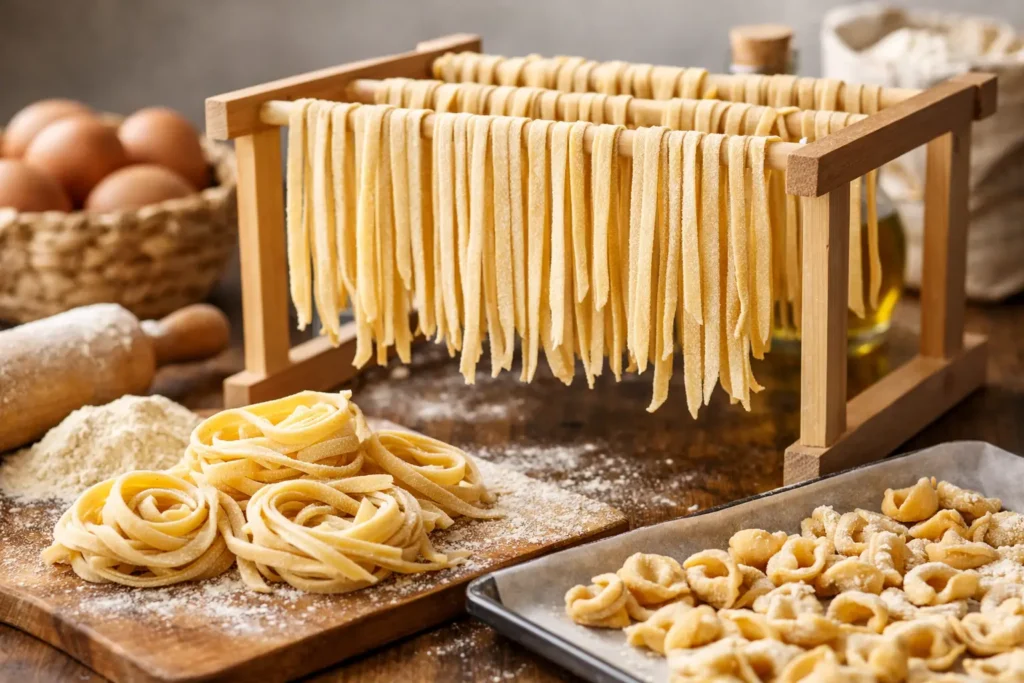
Homemade pasta changes everything – as long as it’s perfect. But all it takes is a single instance of poorly managed drying to end up with sheets that break, tagliatelle that sticks together, or a product that loses its aroma and texture whilst sitting in the cupboard. Understanding how to dry fresh pasta, therefore, is not a technical detail: it is the fundamental step that transforms a good dough into a stable, reliable and high-quality stock, deeply rooted in the culinary traditions of our region.
When it comes to preservation and dehydration, the point is not simply to remove water hastily. The real aim is to reduce moisture gradually and evenly, whilst maintaining the shape of the pasta and preserving its firmness when cooked, its natural colour and all its original organoleptic characteristics. This thoughtful approach applies to those cooking for their own families, and applies even more so to professionals working in a workshop, on a farm, or in a small-scale production facility or artisan pasta maker, where the consistency of the result determines the value of the product on offer.
How to dry fresh pasta properly
The first distinction to make concerns the type of pasta. Egg tagliatelle, pasta made from semolina and water, filled pasta shapes, or lasagne sheets do not react in the same way during the process. The thickness, initial water content, fat content and delicacy of the internal structure all vary. For this reason, there is no single universal cooking time that applies to every recipe or type of pasta.
Generally speaking, fresh pasta dries best when air circulates constantly, in a controlled and uniform manner, across the entire surface of the product. A steady, evenly distributed air flow is far more important than a high temperature. If the heat is excessive or unevenly distributed, the outer part of the pasta dries too quickly, creating an insulating surface barrier, whilst the inside remains moist. The result is pasta that appears dry but is structurally unstable and prone to deterioration during subsequent storage in the pantry.
Proper drying using the Tauro method, which is based on horizontal airflow technology, ensures that the product is gradually dehydrated. This system eliminates the need to turn the baskets or flip the trays during the cycle, as each level receives exactly the same aerodynamic treatment. This preserves the original shape, minimises structural deformation and makes the subsequent long-term storage phase significantly more reliable, actively combating food waste through informed stock planning.
Because fresh air matters more than rushing
Many people mistakenly believe that simply turning up the heat is enough to speed up the drying process. In reality, with fresh pasta, the opposite is often the case. If the process is rushed too much, especially with thin shapes or delicate sheets, there is a risk of visible cracks, brittle edges and abnormal warping of the pasta. With thicker shapes, the danger of rushing is even more real: a perfectly dry outer shell that hides a centre that is still soft and full of free water.
This is why controlled air drying is an effective solution that preserves the quality of the raw material. The logic behind Tauro’s BIOSEC PRO system includes specific programmes, such as the Thin Pasta programme, which is suitable for thin pasta, with a maximum temperature of 42°C and a duration of approximately 20 hours, and the Thick Pasta programme, a programme suitable for thicker pasta, with a maximum temperature of 42°C and a duration of approximately 26 hours, specifically designed for the treatment of fresh pasta, all combined with extremely gentle ventilation. This combination prevents thermal and structural stress on the dough. The airflow operates evenly across all shelves and helps to prevent marked differences between one tray and another, reducing hygrometric imbalances and ensuring a consistent end result in a professional setting.
Preparing the pasta before drying
Before looking at how to dry fresh pasta, it is worth considering an aspect that is often overlooked but crucial: the preparation of the dough and the cutting process. Pasta that has been rolled out poorly or cut roughly will certainly not improve during the drying process. On the contrary, structural flaws and unevenness will become visibly more pronounced by the end of the process.
The sheet of pasta must be of uniform thickness throughout. If some parts are thinner and others thicker, the drying process will inevitably be uneven, causing some areas to become brittle and others to retain a dangerous amount of residual moisture. Care must also be taken when cutting. Tagliatelle, fettuccine and maltagliati must be kept well separated on the shelves from the outset, avoiding compact clumps and limiting the use of excess flour on the surface. Too much dusting flour dries unevenly and can leave the finished product with a dull, whitish or powdery appearance that detracts from its organoleptic quality.
When working with short, extruded or hand-shaped pieces, it is advisable to arrange them in a single, even layer on the trays, leaving sufficient space between each piece to allow air to circulate freely. Filled pastries require even greater care and caution, as the internal moisture content of the filling is significantly higher than that of the outer pastry and the mass is not uniform. In such cases, drying requires slow cycles and constant monitoring, and is not always the best approach for every type of filling.
Egg pasta and durum wheat pasta
Egg pasta is particularly delicate to handle. The presence of egg introduces a significant amount of fat and protein, which directly affects drying times, storage methods and the overall stability of the product. This type requires very careful, gradual and never abrupt drying to preserve the original aromas and prevent alterations to the lipid components. Even after drying, storage must take place under strict, controlled climatic conditions.
Dough made solely from durum wheat semolina and water generally offers a more consistent and forgiving texture. It withstands the dynamics of the drying process better and tends to produce more predictable and consistent results. This does not mean that the production process can be improvised, but that there is greater scope for control and tolerance, especially when working with simple, short shapes or flat sheets without internal fillings.
Temperature and timing: what to really expect
There is no universal figure or fixed baking time that works for every situation or kitchen. Those who look for rigid tables with set times often risk making errors of judgement, because the process is constantly influenced by a multitude of variables: the initial moisture content of the dough, the exact thickness of the sheet, the shape of the chosen format, the temperature and humidity of the external environment, and the total quantity of product placed inside the tunnel.
That said, the correct guiding principle is simple and straightforward: it is always preferable to opt for moderate temperatures and times appropriate to the pasta shape being processed, rather than using high heat in an attempt to force the process to run faster. The pasta must lose its internal moisture naturally, without undergoing thermal shock. When using a Tauro dryer equipped with a well-designed moisture removal system, parameter control is significantly more precise and the final result is consistent from the first to the last basket.
For thin pasta shapes such as tagliolini, the drying times will naturally be shorter and more limited. For thicker shapes, such as artisanal rigatoni, or for very compact nests of tagliatelle, a longer time will be required, and it is advisable to check the condition of the product visually and by hand at various stages of the process. Practical inspection remains the fundamental tool. Correctly dried pasta must be uniformly dry right through to the centre of the shape, appearing firm but free from that glassy brittleness caused by overly aggressive surface drying.
Mistakes to avoid when drying fresh pasta
The most common and widespread mistake is to view drying as a mere passive final stage. In reality, it is a technical process in its own right which, if neglected or poorly managed, risks undermining all the work done previously in mixing and extruding the dough.
A common mistake is to overload the shelves of the baskets. When the pasta is too close together, crammed in or, worse still, stacked in several layers, air cannot circulate properly between the strands. The second mistake is placing a product in the tunnel that is excessively fresh and soft, freshly cut but with no surface structure whatsoever. In many cases, it is useful to employ the technique of brief wrapping at room temperature, allowing the product to settle for a few minutes before starting the guided cycle in the dryer.
Then there is the issue of excessive heat, which causes the surface to dry too quickly, trapping moisture inside. No less important is the management of the final stage: placing the pasta in containers when it is not perfectly dry at the core leads to residual condensation inside the jar, compromising the stability of the preservation. Even the use of containers that are not perfectly sanitised and dry, or storage in damp environments, can undermine all the good preparatory work.
How to tell if the pasta is really ready
The surface appearance aids assessment, but on its own it is not sufficient to determine the success of the process. The dough may appear perfectly dry on the outside yet still contain a critical percentage of water inside. One must carefully assess the tactile consistency and uniformity of the structure by means of a clean break test. A correctly dried tile must not have any soft spots, opaque areas of latent moisture, or abnormal flexibility at the joints or in the thicker parts of the tile.
If in doubt, the Tauro method suggests extending the cycle moderately rather than stopping ventilation too soon. This approach is essential for those who produce small batches of seasonal food and wish to avoid unnecessary waste in the pantry. Conscious storage means respecting the time required by the product, allowing natural evaporation to take its course without resorting to counterproductive technological interventions.
Storage after drying
Once the dehydration process is complete, the pasta must be left to cool completely in a dry, well-ventilated place before being packaged or stored in jars. Placing the product, whilst still warm, into a sealed container would inevitably result in residual micro-condensation forming on the sides. This is a simple step, but a crucial one for the stability of the pantry.
The containers chosen for storage must be clean, completely dry and suitable for protecting the food from moisture in the air and external odours. For small-scale, mindful home production, using small batches that are clearly labelled and stored in glass jars with screw-top or snap-on lids is often the best solution, as this avoids vacuum-sealing, which would ultimately break down the fragile structure of the dried pasta. For professional use in agritourism establishments or workshops, however, it is necessary to establish clear internal standards, carry out constant checks and ensure consistent management of production batches, which can be easily traced using the advanced management systems found on professional machines.
In this context too, the fundamental principle remains the same: the quality of the final product depends not only on the excellence of the original recipe, but also on the consistency and rigour of the method used. Well-dried pasta preserves the value of the work done upstream and helps to showcase local raw materials, supporting seasonal self-production and the logistical organisation of the kitchen or artisan workshop.
When is it best to use a tumble dryer?
Drying pasta simply by using ambient air is only feasible under exceptionally favourable climatic conditions, but offers limited and unreliable control. Relative humidity, seasonal changes and natural ventilation in the room have too significant and unpredictable an impact on the result. For this reason, when seeking consistent quality and food safety, the dryer it becomes an indispensable precision tool, far from being a mere optional extra.
A proprietary system such as the one developed by Tauro Essiccatori allows fresh pasta to be processed in a far more uniform manner than cheaper solutions featuring less consistent vertical air circulation. In day-to-day practice, this translates into a complete absence of quality differences between the various shelves, greater operational reliability and a final product that faithfully reflects the concept of fine craftsmanship: an ancient art form that is not improvised, but carefully managed with the support of advanced technology.
For people who work regularly or who want to make food preservation a practical, everyday choice to combat food waste, having complete control over the process makes all the difference. It is in this context that technical expertise and Italian manufacturing tradition really count. Specialised companies such as Tauro Essiccatori have, over more than thirty years of history, built up a deep-rooted culture of drying, combining scientific methods, continuous training and the utmost respect for the product’s organoleptic properties.
Drying fresh pasta isn’t simply a matter of making it last longer. It means giving it a second layer of structural stability, without causing it to lose its identity, the aroma of the wheat or its original colour. If you start with an excellent traditional dough and work with clean air, ample time and due care, the pasta retains its shape, aroma and character when cooked. And this is precisely where tradition and technology meet: practical design never replaces the skill and sensitivity of the producer, but helps to ensure consistent, high-quality results over time.
An expert’s tip for reducing waste
> When packing dried pasta, it is natural for small fragments or broken pieces of the more fragile shapes to accumulate at the bottom of the baskets or jars. Instead of discarding them, collect these pieces and grind them into a coarse powder using a small food processor or a coffee grinder. This dried pasta flour, rich in semolina and natural thickening properties, can be stored in a dedicated jar and used as a natural flavouring and thickener for vegetable soups, winter minestrone or to thicken homemade sauces and gravies in a completely natural way, eliminating waste in the kitchen.
If you wish to enhance the quality of your artisanal products and discover equipment designed to uphold the culinary traditions of authentic Italian craftsmanship, we invite you to explore the solutions and models offered by Tauro Essiccatori by visiting our official website.
 Italian
  English
  German
  Spanish
  French
  Romanian