




How to prepare dried vegetable chips
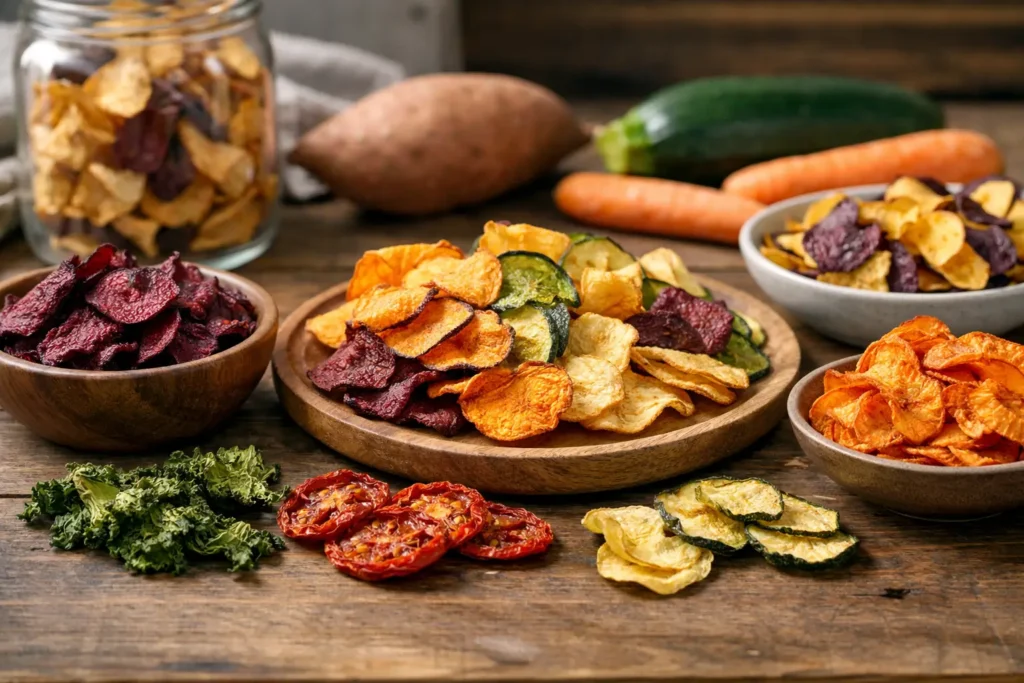
Those who try for the first time to make vegetable chips at home soon realise a fundamental detail: it is not enough to cut thinly and wait for time to pass. To really understand how to make dried vegetable chips requires a conscious approach to the raw material, the rigour of cutting, the management of the free water contained in the vegetables and, above all, the way the air flow interacts with the product. This is where the difference lies between a fragrant, dry and crispy chip and a slice that is only dry at the edges but still chewy in the centre.
Dried vegetable chips offer a real advantage over fried or industrial versions: they allow you to make the most of the seasonality of your garden or local market, drastically limiting food waste and preserving the authentic flavour of vegetable fibres. They are not a trivial dietary alternative. If prepared methodically, they become a versatile ingredient for gourmet cuisine, a healthy snack for the family and a strategic processing for small-scale producers. Giving value to surplus or less attractive gauges for retail is one of Tauro Dryers' historical missions.
How to prepare dried vegetable chips without technical errors
The starting point is the careful selection of vegetables. Courgette, carrots, beets, sweet potatoes, pumpkin, fennel and kale are ideal candidates, but each has a different cell structure. Courgette, composed of over 90% water, requires constant moisture extraction to avoid fermentation; beets, rich in natural sugars, tend to caramelise slightly, intensifying flavour and colour but requiring care not to be too tough. Carrots, on the other hand, retain their original shape well and develop a very concentrated sweetish aroma.
The geometry of the cut
In this process, a constant thickness is not an aesthetic affectation but a technical necessity. To obtain crispy chips, the ideal range is between 2 and 4 millimetres. Slices that are too thin tend to break during harvesting or develop bitter notes if the vegetable is rich in sugar. Conversely, slices that are too thick lengthen the processing time exponentially, making it difficult to achieve the uniform crispness we are looking for.
The use of a well-adjusted mandoline ensures that each slice on the tray has the same height. This allows the dryer to work in a balanced way: if different thicknesses coexist in the same basket, some chips will be ready while others will remain moist, forcing continuous and inefficient manual intervention.
Washing, drying and balancing of condiments
Before cutting, it is a good idea to buffer the water from washing the vegetables carefully. Residual surface moisture is an obstacle that slows down deep evaporation. For particularly watery vegetables such as aubergines or courgettes, a pinch of salt left on for a few minutes can help to purge the excessive vegetation water; the important thing is to dry them well before placing them in the baskets.
As far as seasoning is concerned, the golden rule is moderation. Spices such as sweet paprika, ground rosemary, turmeric or black pepper are perfect to enhance the natural flavour without covering it. Remember that drying concentrates flavours: a seasoning that seems light on fresh will be very intense on dried product. Adding a drizzle of oil will also make the chips really tasty, but beware: oil does not dry out and will make your product more easily perishable. The Tauro experts' advice is to season the already dried chips destined for the aperitif with a drizzle of oil, a few hours before serving!
Guide to choosing vegetables for quality chips
Each vegetable responds in a specific way to hot air. Courgettes like thin slices and sober seasonings. Carrots are the ideal starting point for beginners because of their linear response. Beets, with their earthy note, offer an extraordinary colour impact but must be handled carefully so as not to stain other neighbouring produce. Pumpkin, if chosen from the less floury varieties, gives chips with an enveloping sweetness.
Fennel is an interesting discovery: it will never become flaky like a potato, but will develop a subtle and elegant aromatic texture. Finally, kale follows a logic of its own: being a leaf, drying times are very fast and require constant monitoring to prevent the texture from becoming too brittle. There is no such thing as a superior vegetable, there is the correct method to enhance each specific texture.
Technical parameters: air, temperature and flow management
True crispness is not the result of extreme heat, but of the system's ability to remove moisture gradually and evenly. Horizontal airflow technology, the heart of Biosec systems, is crucial: air flows longitudinally over each shelf, ensuring that there are no pockets of stagnant moisture between trays.
For vegetable chips, the ideal temperature range is between 45 and 55 degrees.
The readiness test
A chip is only really ready once it has cooled down. When hot, the presence of heat-softened sugars and pectins can make it still seem pliable. Take out a test piece, wait a minute and check: if it breaks with a distinct sound, the cycle is over. If it remains rubbery, it needs more time. Given the natural variability of products, it is normal for some slices to be ready sooner than others; in this case, selective removal of the ready pieces optimises the work of the machine.
Avoiding distraction errors
The most frequent mistake is overcrowding the trays. Overcrowding the slices prevents air from lapping over the entire surface of the vegetable, creating damp areas that will spoil the overall crispness of the batch. Another critical point is post-process storage: chips are hygroscopic, i.e. they tend to reabsorb moisture from the air in a few minutes. Pour the product while still warm into airtight containers, preferably away from sunlight.
Towards craft and professional production
Preparing dried vegetable chips is also a valuable skill for agritourism and transformation workshops who want to diversify their offer. The stability of the dried product makes it possible to have a constant commercial proposal all year round, turning the production surplus into a recognised added value. In this field, constancy is everything. Every step must be standardised: from the weight per tray to the temperature set on the electronic control module. Tauro's solutions, designed and manufactured entirely in Italy, offer the necessary precision to make this process repeatable and scalable.
Expert's trick: the final review
If after a few weeks in the cupboard your chips have lost their initial crispness due to frequent opening of the jar, fear not. A brief passage through the dryer (about 30-60 minutes at 55 degrees) is enough to remove the reabsorbed moisture and restore their original fragrance.
The simple way to start is patience combined with observation. Start with a single variety and analyse how its colour and texture changes hour after hour. Drying is a technique that rewards those who respect nature's timing, yielding a product that is the very essence of the starting vegetable.
 Italian
  English
  German
  Spanish
  French
  Romanian