




Professional food laboratory dryer
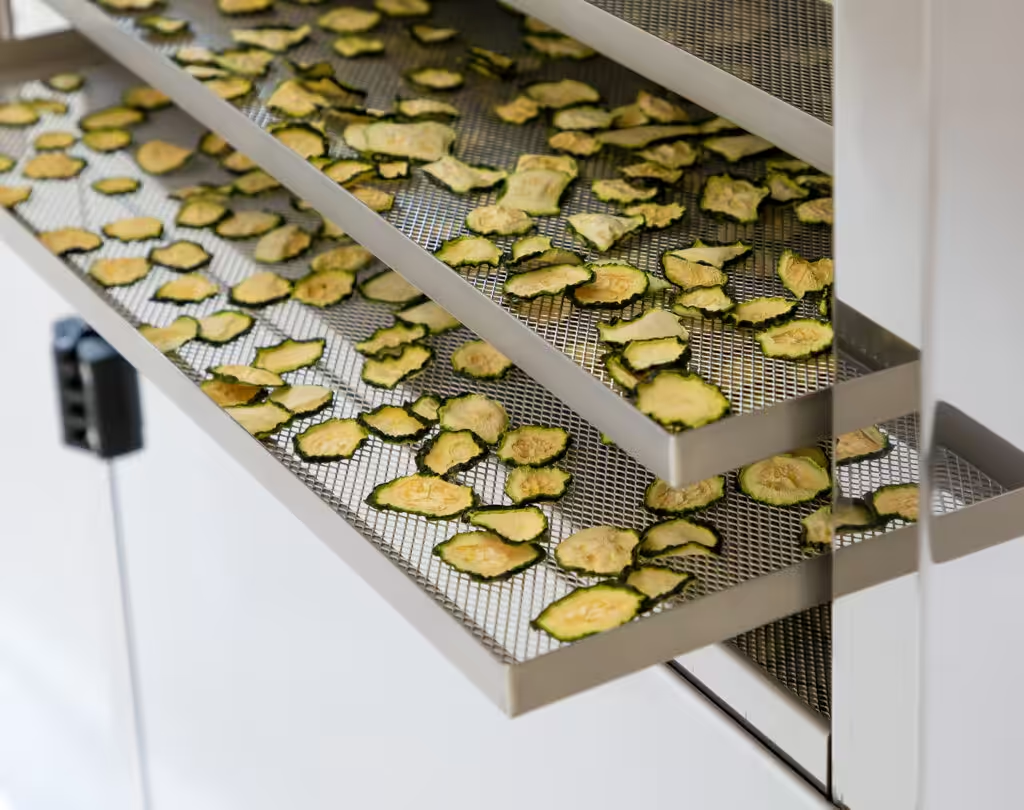
When a craft workshop, a agritourism or one small farm decide to integrate drying into their production processes on an ongoing basis, the main challenge is not simply to remove water from a foodstuff. The real goal is to do it methodically, guaranteeing a clean, uniform and perfectly repeatable result, consistent with the high quality one intends to offer the market. For this reason, the choice of a food laboratory dryer cannot and must not be limited to an assessment of size, price or number of trays.
Those who process fruit, vegetables, herbs, mushrooms, or are dedicated to the creation of dough, crackers, ingredients for herbal teas and gourmet preparations for the Horeca sector, know that drying is an extremely delicate production phase. If the process is handled sloppily, the risk is to lose the original aromas, alter natural colours and create quality discrepancies between one shelf and another, complicating the whole logic of downstream work. If, on the other hand, the process is governed by reliable technology, drying becomes an extraordinary tool for enhancing seasonality, zeroing food waste and expanding one's production range while preserving the essence of the raw material intact.
What a food laboratory dryer really has to do
In the professional as well as the industrial field, a dryer is not just a preservation tool, but a device for standardising excellent processing. This completely shifts the selection criteria towards reliability and technological precision.
A food processing laboratory needs operational continuity. It means having the certainty of being able to process different batches while maintaining a consistent quality standard over time. Each product reacts in a specific way: a sliced apple, a mandolised courgette, a basil leaf or a preparation for raw cooking (RAW) have different evaporation times and temperature sensitivities. A professional dryer must therefore allow millimetre-accurate management of air flow and temperature, eliminating the formation of critical points or moisture stagnation inside the drying chamber.
The decisive parameter is not merely speed, but balance. Too violent a drying process can cause the surface of the product to harden, trapping moisture inside and encouraging potential fermentation or mould during storage. The result of excellence comes from a constant distribution of heat that respects the cells of the food, keeping its properties active and flavour profiles intact.
Horizontal airflow and uniformity of result
When evaluating a food processing laboratory dryer, the ventilation system is the beating heart of the machine. At Tauro Dryers, we have made horizontal airflow logic our production standard, aware that not all flows work with the same effectiveness.
Unlike other systems, the unidirectional horizontal flow invests each tray simultaneously and with the same intensity. Air enters from one side and passes through the products in a linear fashion before being expelled from the opposite side. This system guarantees absolute uniformity: it will never be necessary to invert the baskets during the work cycle to obtain equally dry slices.
For a professional, this translates into a real optimisation of time and human resources. Fewer manual interventions in the process means less margin for error and a programmable and predictable production. It is a substantial difference that becomes clear when working on references that must maintain a precise recognisability on the market, whether for direct sale or for use as semi-finished products in the kitchen.
Temperature, timing and sensitivity of raw material
Each foodstuff has its own temperature tolerance threshold. Medicinal herbs and edible flowers require extremely mild temperatures, usually no higher than 40-42°C, to avoid the dispersion of volatile essential oils. Fruit and vegetables require a balance between 50°C and 55°C to fix colour and texture, while meat and fish require higher temperatures, such as 68°C, to break down the bacterial load safely.
A food laboratory cannot rely on chance. It is essential to use machines with an advanced electronic control, as in Tauro Dryers' professional machines, capable of maintaining stable set conditions regardless of the load inserted. A simple thermostat is not enough; you need technology that can manage the expulsion of saturated air in the initial stages, when the product releases most of its water, and modulate ventilation in the final holding stages.
Expert's trick: The recovery of noble waste
In a professional laboratory, efficiency also means reducing waste. Organic apple peels, mushroom stems or the less noble parts of vegetables, if dried properly and pulverised with a powerful blender or spice grinder, can be transformed into aromatic flours, natural colouring powders or bases for seasonings and stock cubes. This approach not only reduces disposal costs, but also creates new ingredients with high added value for your offering.
Production capacity: modularity and scalability
One of the most frequent mistakes is to buy a plant that is undersized for fear of the investment, or too large compared to the actual raw material supply capacity. In both cases, operational inefficiency is generated.
A dryer that is too small forces exhausting continuous cycles, while one that is too large is uneconomical if not saturated. The correct choice stems from a precise analysis: how many kilos of fresh product do you need to handle per week? Tauro responds to this need with its experience put at the service of the customer and the modularity of the professional BIOSEC PRO and B.MASTER lines: complementary modules can always be added to expand the usable surface area, allowing the technology to grow along with the laboratory's turnover.
One must also consider the nature of the product: aromatic leaves occupy a lot of volume but have little weight, while tomato slices are heavy and water-laden. The useful surface area (measured in square metres) is the real figure to compare in order to understand how much working space you will actually have.
Materials, hygiene and food safety
In a food processing environment, sanitisation is not an option, but a legislative and quality requirement. If a machine has hard-to-reach corners or porous materials, it will become a receptacle for contamination over time.
For laboratories, the choice falls preferably on AISI 304 stainless steel, the material of choice for food contact, durable, inert and easy to clean. In the case of dryers with plastic components, it is essential to ensure that they are BPA-free and phthalate-free, resistant to operating temperatures without releasing undesirable substances.
The internal accessibility and ease of loading and unloading of Tauro professional dryers are factors that affect daily productivity. A robust design, enhanced by Wi-Fi remote control systems, allows production to be monitored remotely, ensuring that the process runs smoothly even at night.
Energy consumption and production sustainability
The topic of consumption is central, but must be analysed with technical expertise. Looking solely at maximum wattage can be misleading: a professional dryer consumes maximum power only during the initial heating phase. During the rest of the cycle, consumption is modulated and very low.
A well-insulated horizontal flow system is inherently more efficient because it avoids heat loss and does not require the machine to be opened to rotate the baskets, an operation that would cause an abrupt drop in internal temperature. For many companies, drying is also a concrete sustainability tool: it allows them to recover “out-of-calibre” products that the large-scale retail trade (GDO) would discard, transforming them into dried delicacies and reducing the environmental impact of their supply chain.
For which activities the investment is strategic
The food laboratory dryer finds application in numerous contexts:
- Farms: to process harvest surpluses into fruit chips or dried herbs.
- Artisan workshops: for the creation of natural snacks, flavoured dry pasta or pastry ingredients.
- Catering and Horeca: to produce edible decorations, garnishing powders and technical bases for innovative dishes.
- Herbalists: for the production of high quality herbal teas, infusions and phytotherapeutic preparations.
In all these areas, the difference lies in the machine's ability to preserve the identity of the product. A well-dried food retains its original colour and releases its full aroma as soon as it is rehydrated or consumed, becoming a trademark for the producer.
How to evaluate the choice before purchase
Before investing, it is useful to ask yourself these questions:
- Which types of products will be dried most frequently?
- What is the average volume of the production batch?
- Will production be constant or tied to seasonal peaks?
- How important is remote control and process traceability (Industry 4.0)?
- Does the supplier offer after-sales technical and training support?
This last point is fundamental: a partner such as Tauro Essiccatori does not just sell a machine, but makes available a wealth of knowledge accumulated over thirty years of research, helping professionals to calibrate their programmes and optimise their recipes.
Drying as a conscious value choice
Adopting drying in a food processing workshop does not only mean extending the life of a product. It means approaching the raw material with a deep respect, turning a peak of seasonal abundance into a stable and lasting economic value.
The ideal machine is one that disappears behind the result, letting the taste, colour and nutritional properties do the talking. Whether it is a small, advanced dryer such as the BIOSEC PRO or a professional installation of the B.MASTER series, quality consistency remains our priority. Choosing Tauro means giving continuity to our vision of food: natural, healthy and deeply rooted in the tradition of Made in Italy excellence.
Discover the complete range and find the best solution for your laboratory needs by visiting our official website or contacting our experts for a dedicated consultation.
 Italian
  English
  German
  Spanish
  French
  Romanian