




How to dry porcini mushrooms well
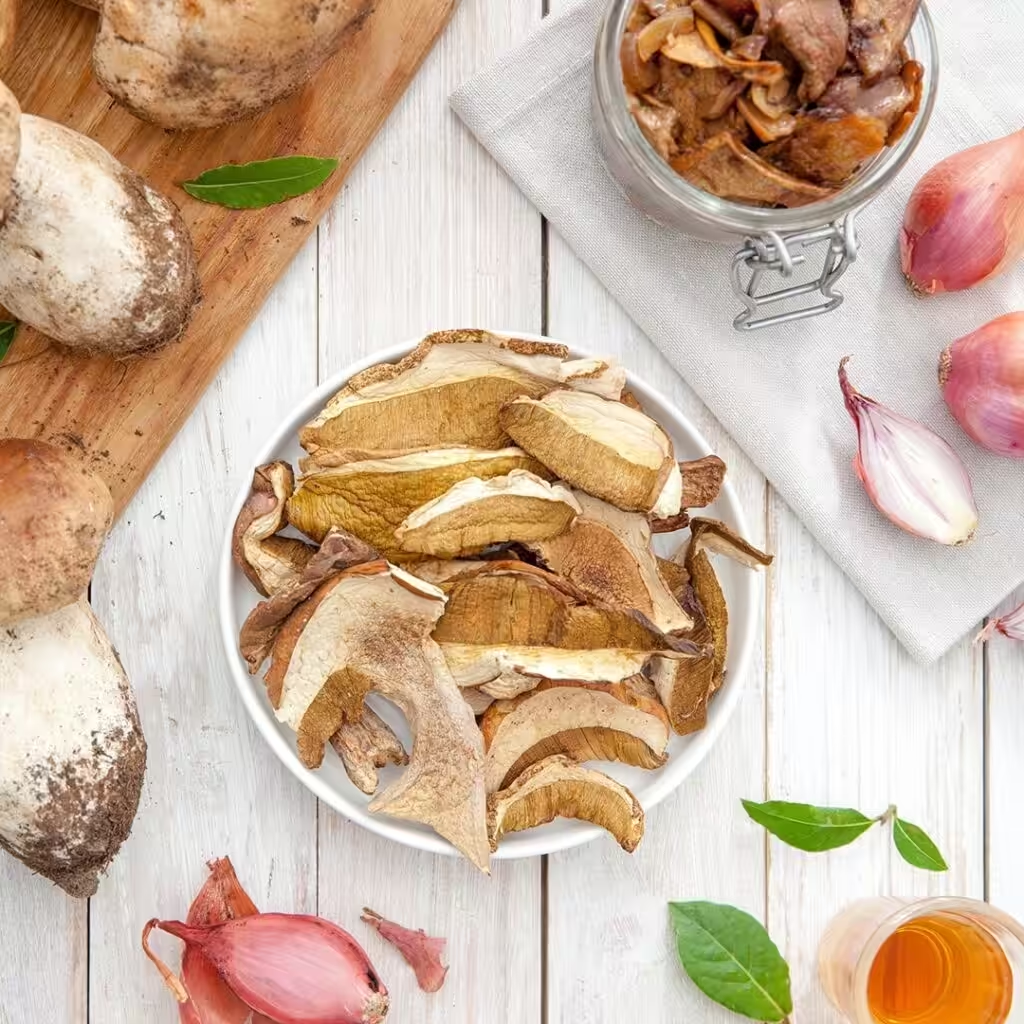
The smell of fresh porcini is a gift of nature that unfortunately has an ephemeral shelf life. Often all it takes is one particularly wet day, a lucky harvest in the thick of the forest or a conscious purchase at the local market to be faced with a pleasant but real challenge: how to preserve this treasure without losing its most precious part, namely the mushroom's deep aroma, characteristic texture and unmistakable identity. Understanding how to dry porcini mushrooms in the right way means exactly this: transforming a delicate, sensitive and strictly seasonal product into a strategic reserve of high quality, ready to enrich the kitchen all year round.
Porcini drying should never be considered a mere fallback for surpluses. If carried out skilfully, it represents a noble, clean and natural preservation technique that deeply respects the balance of the forest and the commitment of those who bring authentic raw materials to the table. This process requires meticulous care in three decisive steps: careful selection of the mushroom, intelligent management of residual moisture and final storage in a protected environment. Neglecting even one of these aspects means risking obtaining porcini mushrooms that are dull, excessively dark or, in the worst cases, not perfectly dry and therefore perishable.
How to dry porcini mushrooms without spoiling aroma and texture
The fundamental starting point is the quality of the raw material. The porcini destined for the dryer must be healthy, compact, intensely fragrant specimens and, if possible, not over-ripe. A mushroom that is already spongy, impregnated with water or worse still, attacked by larvae, will not find redemption in the drying process. On the contrary, dehydration tends to concentrate not only flavours, but also defects and impurities. The best results are obtained with firm specimens, characterised by white or barely creamy flesh and a perfectly intact cap.
The cleaning phase must also be approached with strict criteria and without false myths. Contrary to widespread belief, mushrooms must be washed: as Chef Paolo Dalicandro points out, Tauro's expert collaborator, cleaning cannot be reduced to a simple wipe with a damp cloth if the objective is maximum quality. Porcini should be washed gently and with care, never soaking or leaving them to soak to prevent the porous structure from absorbing too much water, but ensuring that impurities are completely removed. You can help with specific brushes for mushrooms to act with precision. Washing them very well provides considerable organoleptic and hygienic advantages when used in cooking. The secret lies in patting them immediately and carefully after washing to dry them well before cutting. If an area appears damaged or too leathery, it should be trimmed with a sharp knife.
The cut is another factor that affects the final quality more than one tends to imagine. Slices that are too thin risk drying out too quickly, eventually losing much of their cellular structure and, with it, the persistence of the aroma. Conversely, excessively thick slices prolong the processing time exponentially, increasing the danger of uneven drying that could leave the heart of the mushroom still moist. As a general rule, a thickness of between 4 and 6 mm provides the perfect balance. It is possible to treat stem and cap at the same time, provided the same consistency in cutting is maintained. The technical logic is linear: the more uniform the cut, the more evenly the air flow can act, resulting in a standardised, high-profile end product.
The possible methods and the most reliable one
There are historically several ways of approaching porcini drying, but not all of them offer the same level of control and food safety. Open-air drying is the oldest and most traditional method, guardian of an old-world charm linked to mountain life. However, this practice is only effective in an extremely dry, constantly ventilated environment with stable climatic parameters. The modern domestic environment can rarely guarantee such continuity: the variable ambient humidity and temperature changes make the process slow, unpredictable and sometimes risky for the healthiness of the food, which remains exposed to dust and insects for long periods.
The use of the home oven, while appearing to be an immediate and practical solution, has structural technical limitations. Even when selecting the lowest temperatures available, most ovens fail to maintain real thermal stability and, above all, lack the air circulation necessary to remove moisture. The result is that the oven tends to bake or bisque the mushroom rather than dry it. The porcino, being rich in water but extremely volatile in its aromatic components, is immediately affected: it can become excessively dark due to the Maillard reaction (which would be a defect here), lose its natural fragrance or be dry only on the surface.
The dryer remains the tool of choice for those seeking precision and consistency. Working with a continuous air flow and strictly controlled temperature is the only way to respect product integrity. Here, the main technical distinction concerns the direction of air flow. While vertical flow systems tend to become saturated with moisture as they meet the first few racks and require frequent inversion, a horizontal flow system floods each rack simultaneously. When it comes to porcini mushrooms, process control is not a technical fad, but the dividing line between safe storage and a sloppy experiment. For this reason, choosing the dryer correct is the first step towards a professional result.
Temperature and timing: the point at which quality is decided
One of the most frequent errors of judgement is to raise the operating temperature too high in the hope of shortening the waiting time. With a product as noble as porcino, haste is the enemy of quality. Too much heat causes premature hardening of the outside of the slice (a phenomenon known as case-hardening), creating an impermeable barrier that traps residual moisture inside. In addition, temperatures above 55 degrees can alter the enzymatic and aromatic profile of the mushroom, causing it to take on bitter or over-roasted notes.
The ideal temperature range is between 40 and 50 degrees centigrade. In Taurus we often recommend 45 degrees as provided for in the P2 programme of Biosec systemswhen you want to maximise the aromatic yield and preserve the natural colour of the flesh. The duration of the cycle is influenced by several variables: the thickness of the slices, the overall load on the racks, the initial hygrometry of the mushroom and the conditions of the outside environment. On average, a complete cycle can take between 8 and 14 hours. It is fundamental to accept that there is no universal timer valid for every harvest: every mushroom tells a different story.
A cep collected after a week of drought will have very different response times than one found after a summer storm. The density of the flesh between the stalk and the cap also plays a role: the stalk, being structurally denser, may require a slightly longer residence time. Thanks to the horizontal flow system, there is no need to rotate the shelves, as the air arrives identically at each level of the tunnel, ensuring that no slice is left behind in the process.
The cep can be said to be properly dried when it is dry to the touch, elastic but not flabby, and shows a tendency to break when subjected to firm pressure, without revealing cold or sagging areas in the centre. If the slice still appears “rubbery” or cold inside, it means that the evaporation process is not complete. It is always preferable to extend the cycle by a few hours rather than risk storing a product in jars that could develop mould during storage.
How to arrange porcini in the dryer
The arrangement of the pieces on the baskets is a crucial operational step. The slices must be laid out in a single layer, carefully avoiding overlapping. The secret of perfect drying lies in allowing the air flow to circulate freely around each individual mushroom slice. Over-saturating the trays does not lead to time savings, but generates the opposite effect: it creates areas of moisture stagnation that make the process uneven and qualitatively poor.
If your collection includes porcini of widely varying sizes, a good practice is to dedicate different baskets to different sizes. This expedient allows you to take out the smaller pieces once they are ready, leaving the larger ones to complete their journey without suffering unnecessary heat stress.
For those working in professional settings, such as farms or processing laboratories, repeatability of the result is the main objective. A standardised process makes it possible to reduce processing waste and offer the market a product with consistent organoleptic characteristics. It is in this furrow that the technical experience gained over decades of research makes the difference: Tauro Essiccatori does not just supply machines, but promotes a drying culture based on expertise and respect for the raw material.
Frequent mistakes when trying to understand how to dry porcini mushrooms
The first and most serious mistake is the initial selection: a porcini that is too advanced in its ripening stage or already deteriorated cannot be “saved” by the dryer; the unpleasant notes would only be amplified. The second error concerns cleaning: not washing the mushrooms properly or not blotting them immediately afterwards exposes the product to unpleasant residues or excess surface moisture. The third is the unevenness of the cut, which forces aromatically impoverished slices and still moist slices into the same basket.
Then there is the risk of insufficient monitoring. Relying blindly on a timer without visually and tactilely checking the evolution of the fungus can lead to poor results. Finally, sloppy storage is a major cause of disappointment. If the dried mushroom is exposed to air before packaging, it will immediately begin to reabsorb the ambient moisture, losing the crispness that is a guarantee of stability over time.
Conservation: work does not end when drying is complete
Once removed from the tunnel, the slices must be left to cool for a few minutes before being placed in the containers. This interval serves to stabilise the product, but should not be too long to avoid spontaneous rehydration. The containers of choice are hermetically sealed glass jars, perfectly clean and, above all, free of any trace of internal moisture. The aim is to create an impenetrable barrier against air, light and moisture.
The ideal storage place for your porcini stock is a cool, dry place, strictly protected from direct sunlight and heat sources. If the process has been carried out properly, the porcini will retain their properties for more than twelve months, although the peak of fragrance is usually appreciated within the first half of the year. A periodic visual check is recommended: the appearance of condensation on the walls of the glass or a loss of friability of the pieces are unmistakable signs that the product needs to be checked or, if necessary, returned to the dryer for a short finishing cycle.
Expert's trick: the freezer pass against unwanted guests
A common problem with dried products is the possible hatching of moth eggs (the so-called food moth), which can be present on fresh mushrooms from the forest. To sleep soundly, after sealing the porcini in glass jars, place them in the freezer for 24-48 hours. The sub-zero temperatures will inactivate any larvae or eggs without altering the dried mushroom at all, which, having very little water, will not suffer structural damage from the frost. Once removed, allow the jar to return to room temperature before opening to avoid condensation.
How to use them after drying
Dried porcini mushrooms are an incredibly versatile ingredient, but require conscious handling to realise their full potential. The standard procedure is to rehydrate them in lukewarm water (not boiling, so as not to “cook” the mushroom prematurely) for about 20-30 minutes. The water resulting from the soaking is a true forest concentrate: after being carefully filtered through a fine-meshed strainer or gauze to remove any earthy residue, it can and should be used to cook risottos, enrich sauces or bottoms of cooking.
However, modern cooking also suggests alternative uses. Perfectly dried porcini can be reduced to a very fine powder using a common coffee grinder. This powder becomes a formidable “secret ingredient”: it can be incorporated into fresh pasta doughs, used to flavour gourmet breadcrumbs, mixed with salt to create an instant condiment or added raw to a velouté just before serving. It is also a clever solution for enhancing smaller fragments or slices that have broken during handling.
Drying a porcino correctly means choosing the path of technical precision against the uncertainty of improvisation. It means honouring a precious ingredient that is born of a delicate natural balance, transporting it through time without altering its soul. When the process is guided by the right technology and a passion for quality, every single slice will be able to return the intensity, purity and memory of the forest to the plate.
Are you ready to create your own store of authentic flavours? Explore Tauro Dryers' professional and domestic solutions to take your cooking to the next level of awareness and taste.
 Italian
  English
  German
  Spanish
  French
  Romanian