




Drying for direct sales: how to do it right
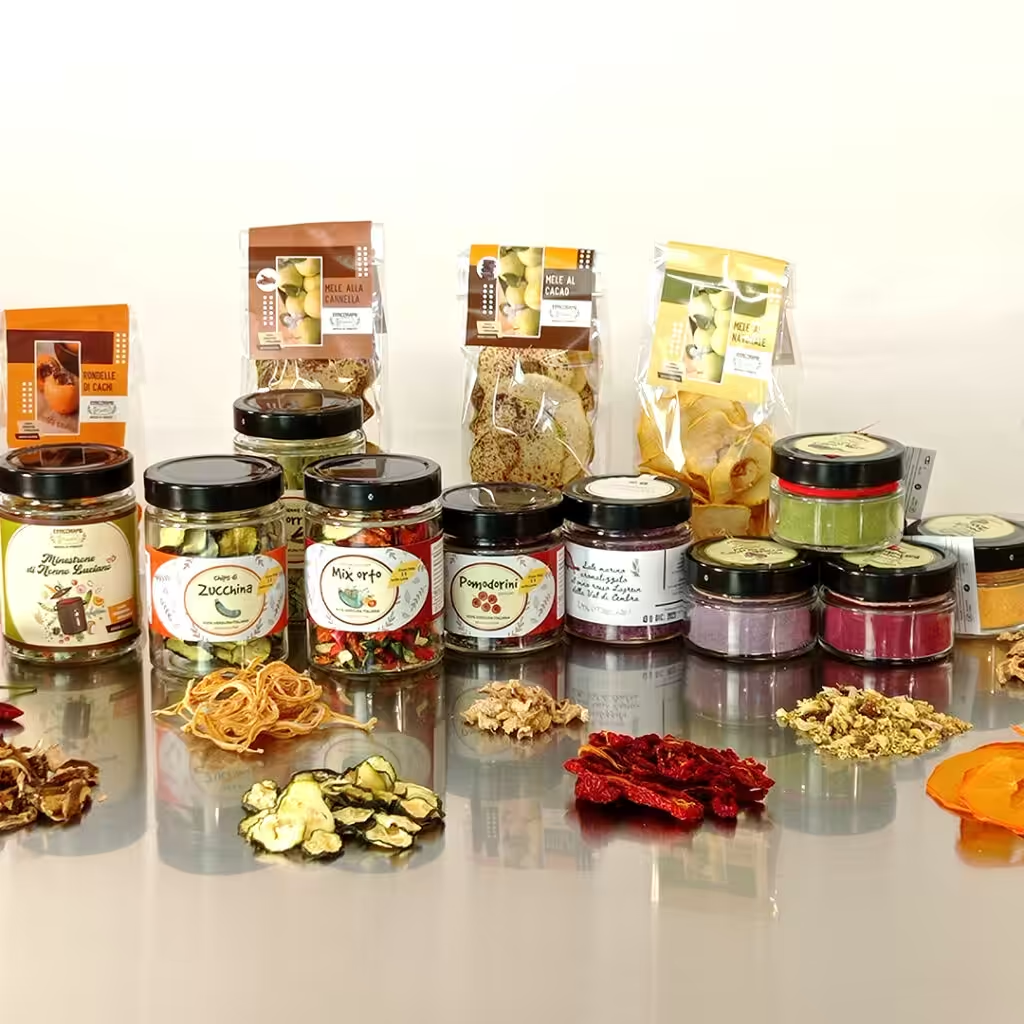
Those involved in direct sales know well the frustration of seeing an excellent, fragrant and healthy harvest lose its commercial value in a matter of days. Perfectly ripened strawberries that do not hold up to transport, aromatic herbs that wither quickly on the counters, apples of irregular size discarded by large retailers or vegetables so abundant in the middle of the season that they saturate local demand: it is precisely in these scenarios that the ’direct sales' department is able to offer its services.’professional drying for direct sales proves to be a forward-looking strategic choice.
Choosing to dry is not a simple response to a passing fad, but means transforming seasonality into a stable business opportunity. Through this process, it is possible to offer products that preserve the fragrances, colours and deep identity of the territory throughout the year. Drying does not only serve to preserve; it serves to give operational continuity to the short supply chain, to expand the assortment of the farm shop, to drastically reduce food waste and to build a commercial proposal consistent with a conscious and regenerative agriculture. For a’farm, a craft workshop, a farmhouse or a small food business, the dryer becomes a serious production lever, provided it is approached with a rigorous method and the correct tools.
Why drying for sale is a competitive advantage
The sale of the dried product is based on human relations, trust and the recognisability of the company brand. Those who choose to buy at the farmer's market, directly on the farm or through proximity channels, are not looking for anonymous industrial standards, but for authentic and perceptible quality. A carefully dried product tells the story of work in the fields in a crystal-clear way: it starts with the fresh raw material, respects its original organoleptic profile and prolongs its availability without using preservatives or added sugar.
This approach is especially successful when primary production is subject to unpredictable seasonal peaks. Drying makes it possible to stabilise the surplus, enhancing even those fruits that, although perfect in flavour, have aesthetic defects that would prevent them from being sold as a fresh product. However, not all products lend themselves to the market in the same way. Some foods provide excellent yields and immediate appeal, while others require a more in-depth narrative to make the customer understand the value of the dehydrated product.
A crucial aspect for the sustainability of the business is the economic margin. The dried product is, by its very nature, a concentrate of flavour and nutritional value. If we consider that the weight yield ratio is on average 1 to 10 (ten kilos of fresh produce yields approximately one kilo of dried produce), it is evident that the selling price must reflect not only the concentration of the raw material, but also the labour required for washing, cutting and packaging. This allows the dried product to be positioned in a premium bracket, breaking away from the price war that often characterises the fresh sector.
Which references to favour for the local market
When setting up a line for direct sales, it makes sense to start with products that balance three factors: consistent quality yield, ease of use for the end consumer and versatility in cooking. Fruit is often the ideal entry point. Apples, pears, figs and plums find immediate favour as healthy snacks. Dried strawberries, in particular, are highly sought after for their ability to retain an explosive aroma that makes them perfect for garnishing desserts or enriching breakfast.
Turning to vegetables, the tomato remains a mainstay of the Mediterranean tradition, but courgettes, mushrooms and onions are also finding increasing space, especially with a public attentive to natural cooking and reduced preparation times (sautéed preparations or ready-to-use soups). Aromatic and medicinal herbs, although very interesting, require extremely gentle heat management so as not to disperse the volatile essential oils.
The strategic choice must always be contextualised. An agritourism could focus on identity references linked to the recipes served at the table, such as vegetable powders used as flavourings. A farm with large extensions could instead use drying to manage large volumes of seasonal surplus. The secret lies not in drying everything that is left over, but in selecting produce that, once dehydrated, retains a high gastronomic value.
The quality of the dried product starts before the dehydration process
A frequent mistake among newcomers is the belief that the dryer can correct a poor quality raw material. On the contrary, drying enhances every characteristic, merits and defects included. The quality of the finished product stems from the choice of the perfect ripening time: a fruit that is too unripe will be sour and low in sugar, while one that is too ripe may present difficulties in cutting and excessive drying time.
Preparation is a decisive step. The cut must be as homogeneous as possible; slices of different thicknesses within the same batch will lead to uneven drying, with the risk of placing pieces in the packaging that are still damp, which could trigger mould and compromise the entire batch. The cleaning and organisation of tray loading must follow the logic of efficiency but also of strict hygiene, especially in professional contexts subject to HACCP regulations.
For direct sellers, consistency is the first indicator of professionalism. The loyal customer expects the pack bought today to be identical to that of the previous month. If the quality fluctuates between one batch and the next, consumer confidence wavers. This is why the use of preset programmes and temperature control technologies, such as those found in Tauro Dryers' systems, is essential to guarantee a repeatable standard of quality.
Horizontal airflow architecture in professional production
In direct sales, drying uniformity is not just a technical detail, but an economic requirement. In a vertical airflow system (very common in economy appliances), humid air saturates the upper baskets, forcing the operator to make continuous manual interventions to exchange trays. This not only increases labour costs, but also creates inhomogeneity in the final product.
The horizontal airflow system, the heart of Tauro's technology, solves this problem at its root. Air flows through each shelf in a parallel and uniform manner, ensuring that every slice, from the first to the last tray, receives the same heat treatment and ventilation. This physical principle results in perfectly stable batches, reducing waste and improving the aesthetic presentation of products in transparent packs.
Having an orderly and predictable process enables better planning of work sessions. When processing different products at the same time, the unidirectional flow also prevents flavour contamination between the baskets, allowing the dryer load to be optimised without quality risks. This efficiency translates directly into increased profitability for the farm or food processing laboratory.
Creating a product line: from catalogue to packaging
It is not necessary to start with dozens of different references. Often, for a business entering this market for the first time, it is more prudent to build a catalogue of three or four impeccably produced products, closely linked to the corporate identity. It is essential to analyse what is already being produced in abundance and what the specific demand of one's user base is.
Pack size is a powerful marketing tool. Small sachets of 20-30 grams can serve as a taste or snack ready for immediate consumption, while larger formats of 100-200 grams appeal to those who use the dried product as a regular ingredient in the kitchen. On the sales counter, clarity of labelling and storytelling is vital: the consumer must immediately perceive the difference between an apple dried naturally on the farm and an industrial product treated with sulphur dioxide or added sugar.
Taste education and managing expectations
Introducing natural dried products in direct sales also means embarking on a journey of customer education. Many people are accustomed to industrial products that retain bright colours thanks to additives or rubbery textures due to correct partial drying with preservatives. Explaining that a slightly dark dried tomato is a sign of a natural process without chemical bleaching agents is an act of transparency that ennobles the farmer's work.
Direct sales allow people to taste the product, explaining how it was grown and processed. Telling that drying concentrates up to ten times the nutritional properties and flavour of a fresh vegetable transforms a simple purchase into a conscious choice. This technical expertise, when communicated with passion and precision, justifies the price and creates a profound bond with the public, who stop being mere buyers and become supporters of the company's project.
Drying as a structural investment for the future
There comes a point in the growth of a company when drying ceases to be a sporadic activity and becomes a mainstay of turnover. This happens when the demand for dehydrated products becomes constant and it is realised that the processed product guarantees cash flow continuity even when the fields are idle. At this stage, the choice of reliable professional equipment is no longer an option.
Investing in a system designed specifically for food use, with certified materials such as AISI 304 stainless steel and advanced electronic systems oriented to Industry 4.0 with standard remote control, allows you to scale up production while maintaining high margins and minimal risks. The culture of drying, promoted by realities such as Tauro Essiccatori, does not stop at the sale of the machinery, but accompanies the farmer and the artisan through technical assistance and the sharing of applied scientific knowledge.
Drying for direct sale, if done with method and passion, does not only mean extending the life of a foodstuff. It means protecting the economic value of agricultural work, giving a new and noble form to surplus and ensuring that the quality of the earth arrives intact on people's tables, season after season.
Find out how to integrate professional drying into your business and learn about the models in the professional line Tauro Dryers, See our dedicated catalogue or contact us for a tailor-made consultation.
 Italian
  English
  German
  Spanish
  French
  Romanian