




Natural vs. oven drying: what changes
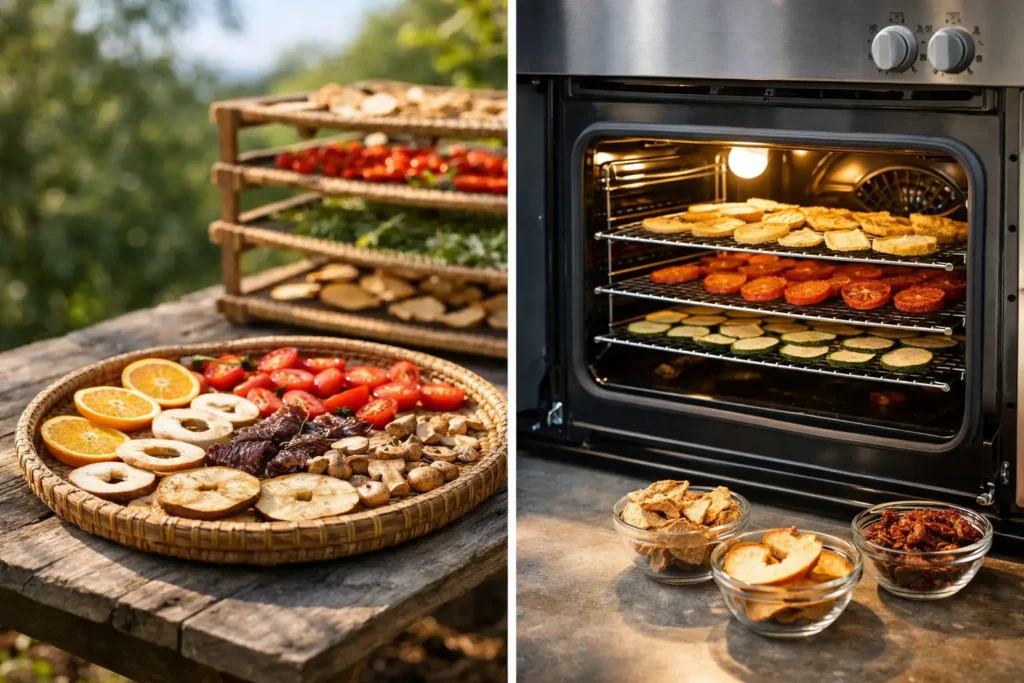
Anyone who tries to preserve fruit, vegetables, herbs or mushrooms with an oven soon realises: drying is not enough. The real issue, when it comes to natural vs. oven drying, is to understand how to remove water in a controlled manner, without cooking the product and without compromising its aroma, colour and organoleptic structure.
The misunderstanding arises from an only apparent similarity between the two methods. Both the oven and the dryer work with heat, but the purposes and physical dynamics are profoundly different. In the oven, heat is designed to induce rapid chemical transformations, i.e. to cook. In professional or high-quality domestic drying, on the other hand, heat has the sole task of accompanying the evaporation of water gently, steadily and continuously. It is a substantial technical difference that determines success or failure in the dish, stability in the jar and, above all, shelf life.
Natural vs. oven drying: the real difference
When deciding to dry a food well, the primary objective should never be speed. The goal is to remove water gradually and evenly, preserving the integrity of fibres and nutrients. This principle applies to every raw material: from thinly sliced apples to fleshy tomatoes, from herbs rich in essential oils to mushrooms, and even more advanced preparations such as powders or fruit sheets.
The domestic oven is not structurally designed for this task. Even when selecting the lowest temperatures available, one comes up against a baking-oriented design. The heat in the oven is often static or moved by ventilation that is not optimised for constant moisture extraction. In addition, the actual heat control can fluctuate significantly from what is indicated on the display or knob, creating overhangs that damage the product.
In contrast, a dryer like the Biosec is designed to create the perfect microclimate for dehydration. The secret lies not only in the temperature setting, but in the way air and heat interact with the food. Thanks to the horizontal airflow system, typical of the Tauro philosophy, each shelf is simultaneously hit by a constant blast of air. This ensures even drying and prevents moisture stagnation, without people having to constantly reverse the position of the racks.
Why the oven tends to bake rather than dry
Many people initially choose the oven for a matter of apparent practicality: it is an appliance already present in every kitchen and does not require an initial investment. For very small experiments it can be a starting point, but structural limitations immediately emerge as soon as quality is sought.
The first obstacle is the minimum effective temperature. Many modern ovens struggle to maintain stable temperatures below 50-60 degrees. For delicate foods such as herbs or for those following a raw diet (which requires not exceeding 42-45 degrees to preserve enzymes), the oven is too aggressive. Excessive heat alters flavours, darkens fruit and gives vegetables that typical “baked vegetable” taste, which has nothing to do with the concentrated freshness of properly dried produce.
The second critical limitation is moisture management. During drying, evaporating water must be removed immediately from the room to avoid the “boiling” effect. In the oven, steam tends to stagnate, often forcing the door to be left ajar. This compromise is extremely inefficient: it causes enormous heat loss, makes the process unstable and increases energy costs unjustifiably.
The third point concerns air distribution. Without a constant laminar flow, some areas of the tray will dry too quickly (risking burning the edges), while others will remain soft. Those who use the oven are forced to keep a constant watch, rotating the trays and turning the products, a commitment that a dedicated dryer totally eliminates thanks to the automation of cycles.
What is really meant by natural drying
The term natural drying is often misunderstood. It does not simply mean exposing food to the sun or open air without protection, a practice that exposes food to aggressive UV rays, dust and insects. Instead, it means replicating the action of wind and gentle heat in a protected environment, respecting the physiological timing of the raw material.
Natural, in the sense of Tauro Dryers, means not forcing the product towards thermal degradation. A naturally dried apricot must retain the flavour and colour of the fresh fruit, but in a concentrated form. A sage or mint leaf must retain its aromatic vibrancy and not turn into a dull residue devoid of essential oils.
To achieve this, airflow control is as important as temperature control. Consistent ventilation ensures that dehydration also takes place in the core of the product, guaranteeing the food safety required for storage that can easily exceed twelve months in a simple glass jar.
Final quality: colour, scent, consistency
The visual and sensory comparison between natural vs. oven drying is merciless. Fruit treated with a horizontal flow dryer retains brilliant colours and vivid aromas. This happens because water is removed so quickly from the surface that it prevents most of the oxidation processes that blacken food.
Texture is another key factor. Proper thermal management produces regular textures: crispy slices (the so-called crock effect) but not vitrified, herbs that crumble under the right pressure, mushrooms that retain their internal elasticity for perfect rehydration. In the oven, on the other hand, you often get a product that is dry on the outside but still moist on the inside, a very dangerous condition that leads to mould formation in a very short time once the food has been placed in the larder.
For those who value their garden harvest or for professionals seeking to differentiate their offerings, consistency of result is vital. It is not enough for the food to be “dry”; it must be excellent, replicable and safe.
Time, fuel consumption and practicality: it's not just speed that counts
At first glance, the oven may seem faster. In reality, if you calculate the time spent monitoring the process and the energy wasted due to poor insulation or an open door, the advantage vanishes. A quality domestic dryer is designed to work around the clock with absolute thermal stability.
On the consumption side, the gap is clear. A Tauro Biosec dryer has a 550W heating element, but during maintenance phases or with delicate programmes, the average consumption drops dramatically, fluctuating between 15W and 350W. A domestic oven usually consumes around 2000W-2500W each time the heating element is activated. Drying for 12-24 hours in an oven means electrical costs disproportionate to the volume of product obtained.
When the oven can fit
Let's be clear: the oven is not a tool to be demonised. For sporadic trials, for those who simply want to test whether they like the taste of a home-made sun-dried tomato, it can be a first step. It is an acceptable compromise for very small quantities of products that are not too watery and not too delicate. However, be aware that you are working with an “adapted” and non-specific instrument.
When it pays to have a dedicated dryer
Buying a dedicated dryer pays off when drying becomes a conscious cooking philosophy. It pays off for those who want to drastically reduce food waste by recovering seasonal surpluses or waste parts (such as peels to make homemade vegetable stock cubes). It suits those who seek self-sufficiency in producing healthy snacks for the family, customised herbal teas or ready-to-use ingredients.
In this context, Tauro technology and the DrySet Pro system offer specific programmes for every need: from the Automatico for beginners, to the BioCrudista for maximum protection of nutrients, to the Superhot for those who want speed or need to process meat and fish safely. Made in Italy here is not just a label, but a guarantee of materials certified for food contact and craftsmanship that has lasted for over thirty years.
The Expert's Trick
To get really crispy apple or courgette chips, do not just dry them. Once the standard drying cycle (usually 50°C) is complete, switch to the P4 Superhot programme (68°C) for the last hour of processing. This final “heat shot” removes the very last traces of moisture and crystallises the sugars, giving a professional crispness. Remember to pot the product while still hot in an airtight glass container to prevent it re-absorbing moisture from the air.
Natural vs. oven drying: which one to choose really
The choice depends on your objectives. If the objective is the mere survival of a foodstuff for a few days, the oven may suffice. If, on the other hand, you want to respect the agricultural work behind each fruit, if you want to bring the true essence of the flavours to the table and if you are looking for storage that lasts a whole year, the dryer is the only logical choice.
Moving from the oven to the dryer means moving from improvisation to food culture. It means giving value to time and nature, bringing products into one's larder that maintain an authentic and profound link with the original ingredient.
Are you ready to discover how easy and rewarding natural drying can be at home? Explore solutions Tauro Dryers and join our community of nature conservation enthusiasts.
 Italian
  English
  German
  Spanish
  French
  Romanian