




What is the best saffron dryer?
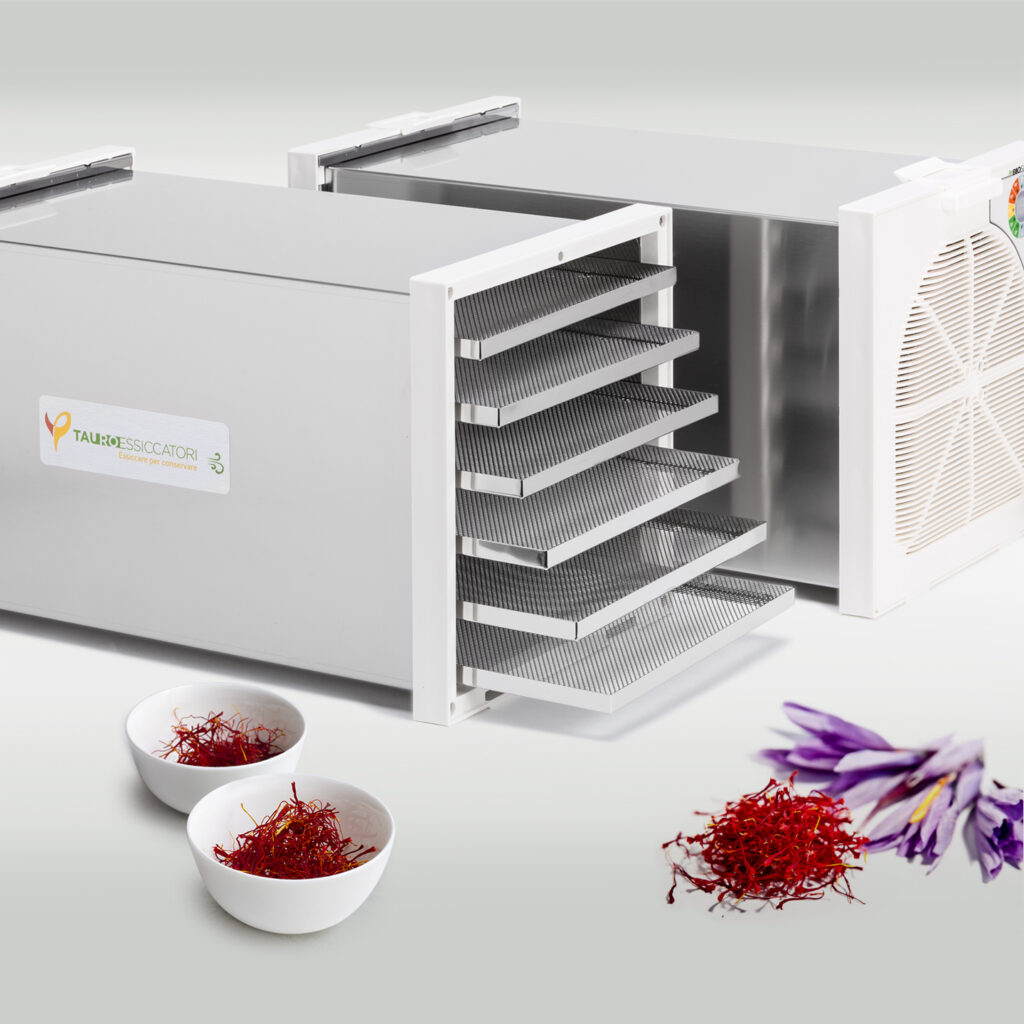
Saffron tolerates no half-measures. Each flower yields just three stigmas, which are harvested by hand within a short period and separated with patience: to lose even a fraction of their fragrance, colour or integrity is to diminish the value of this meticulous agricultural work. For this reason, when asked What is the best saffron dryer?, the answer is not a single model that suits everyone. It is a dryer capable of delivering clean, consistent and evenly distributed air, with controls tailored to the volume of the harvest and the quality to be preserved.
Drying is the process that stabilises the stigmas and makes it possible to preserve them. However, it is not simply a matter of removing water: it is a delicate stage, during which excessive heat, an uneven flow of air or poorly controlled timings can adversely affect the aromatic notes and the appearance of the finished product.
The best saffron dryer is one that operates uniformly
Saffron stigmas are very light in weight and have a very thin surface. This characteristic requires a gentle and consistent process. The aim is to reduce the moisture content evenly, without subjecting the product to sudden temperature changes or areas with insufficient ventilation.
A suitable dryer must therefore provide an adjustable and stable temperature, continuous ventilation and an even distribution of air across the shelves. The horizontal airflow, which forms the basis of the Biosec system, meets this requirement precisely: the air flows evenly across the shelves, ensuring that the stigmas closest to the heat source are not treated differently from those further away.
In vertical-flow systems, on the other hand, the air flows through the trays from the bottom upwards or vice versa. With products that are so light and delicate, this may make it necessary to check the results more frequently and rotate the shelves, as conditions can vary along the length of the column. This does not mean it is impossible to dry saffron in this way, but a horizontal airflow makes it easier to achieve uniformity, especially when aiming to standardise the process from harvest to harvest.
What to consider before choosing a tumble dryer
To make the right choice, it is best to base your decision on your actual output, not just on the machine’s stated capacity. A family-run farm with a modest quantity of flowers will have different requirements to a commercial farm, a farm holiday business or a workshop that wishes to package and market saffron.
Temperature accuracy and process continuity
It must be possible to set the temperature precisely and maintain it over time. Saffron does not benefit from aggressive treatment: the balance between heat and air circulation must promote gradual drying, whilst preserving the compounds responsible for its colour, aroma and flavour.
There is no one-size-fits-all method that can be copied without testing. The degree to which the flower has opened, the environmental conditions at the time of harvesting, the quantity loaded and even the altitude can all affect the drying times. A good dryer therefore allows you to work consistently and refine your own method, rather than relying on unregulated heat.
Shelves suitable for a lightweight product
The stigmas must be spread out in a thin layer, without any clumps. When the product is too concentrated, air struggles to reach every part of the batch and there is a risk of uneven drying. Well-designed shelves, the fact that they are easy to clean and suitable for holding small quantities is a real advantage.
When it comes to saffron, it may be useful to use non-stick trays, provided they allow air to circulate freely. Practicality is also important: during harvesting, which often takes place every morning for several days, being able to load small batches in an orderly fashion helps you work with greater precision.
Capacity consistent with the harvest
The key criterion is the ability to handle the daily harvest at the peak of flowering, without crushing the stigmas and without having to delay drying for too long.
For domestic use or small-scale production, a compact yet reliable dryer may be sufficient. For those cultivating larger areas or processing saffron professionally, factors such as load capacity, continuous operation, ease of sanitisation and consistent results become increasingly important. In both cases, the machine must adapt to the pace of the harvest, not the other way round.
Materials, cleaning and service
Saffron is a high-value foodstuff and deserves a supply chain where every detail is carefully managed. Materials suitable for food contact, easy-to-clean surfaces and robust components all help to ensure efficient operations. After-sales support is also a key consideration: for food producers, being able to rely on clear instructions, spare parts and technical support It is part of the investment’s quality.
A ‘Made in Italy’ dryer designed by a specialist such as Tauro Essiccatori can be valued not only for the machine itself, but also for the wealth of experience that comes with using it: manuals, training materials and practical knowledge of food drying.
How to dry the stigmas more carefully
The final quality is determined before the product even reaches the dryer. The flowers should ideally be picked whilst they are still closed or just beginning to open, during the coolest part of the day, and then trimmed with clean hands and the utmost care. Separating the stigmas without crushing them takes time, but ensures that the product remains intact.
Once removed, the stigmas should not be left exposed to light, moisture or foreign odours for any longer than necessary. They should be placed on the shelves straight away, well spaced apart. Even distribution is not merely a matter of aesthetics: it ensures that air can reach every part of the product equally effectively.
During the drying cycle, avoiding frequent opening of the lid helps to maintain stable conditions. It is more useful to establish a method, note down quantities, settings and times, and then assess the result at the end of the process. This simple log becomes invaluable over the years: it allows you to compare different harvests and identify the drying point best suited to your production.
Properly dried stigmas should appear dry and brittle, without looking burnt or having lost their fragrance. Once completely dried, they should be stored in clean, dry and tightly sealed containers, away from light. The subsequent resting period allows the aromas to settle: this is why saffron should not be judged immediately after drying is complete.
Mistakes that can reduce the quality of saffron
The first mistake is to treat saffron as a’aromatic herb any. Its structure, value and sensitivity require greater care. Excessive heat can diminish the flavour profile and alter the colour; conversely, a cycle that is too long or insufficiently ventilated can result in a product that is not sufficiently stable.
Another common mistake is overloading the shelf. Even with a good dryer, a pile of stigmas restricts the flow of air and makes it difficult to achieve an even result. The same rule applies to waiting: leaving fresh stigmas for too long before processing exposes the harvest to avoidable spoilage.
Finally, storage must not be overlooked. Drying only protects the product if it is followed by careful packaging. Moisture, direct light, heat and containers that are not properly sealed can, over time, undermine the work carried out in the field and in the laboratory.
The right choice depends on the project, not just on the machine
For a small-scale self-production, the best saffron dryer It is what allows you to work with just a few grams with precision, without waste and without complications. For those who wish to sell their harvest, The decision must also take into account the regularity of the process, the management of seasonal peaks and the opportunity to establish a recognisable quality standard.
The dryer is no substitute for careful cultivation or meticulous sorting, but it can preserve the value of both. Choosing a system with even air distribution, controllable parameters and an appropriately sized capacity means showing respect for a rare ingredient, the work of those who grow it and the authentic character of each harvest.
 Italian
  English
  German
  Spanish
  French
  Romanian