




Professional Dryer Buying Guide
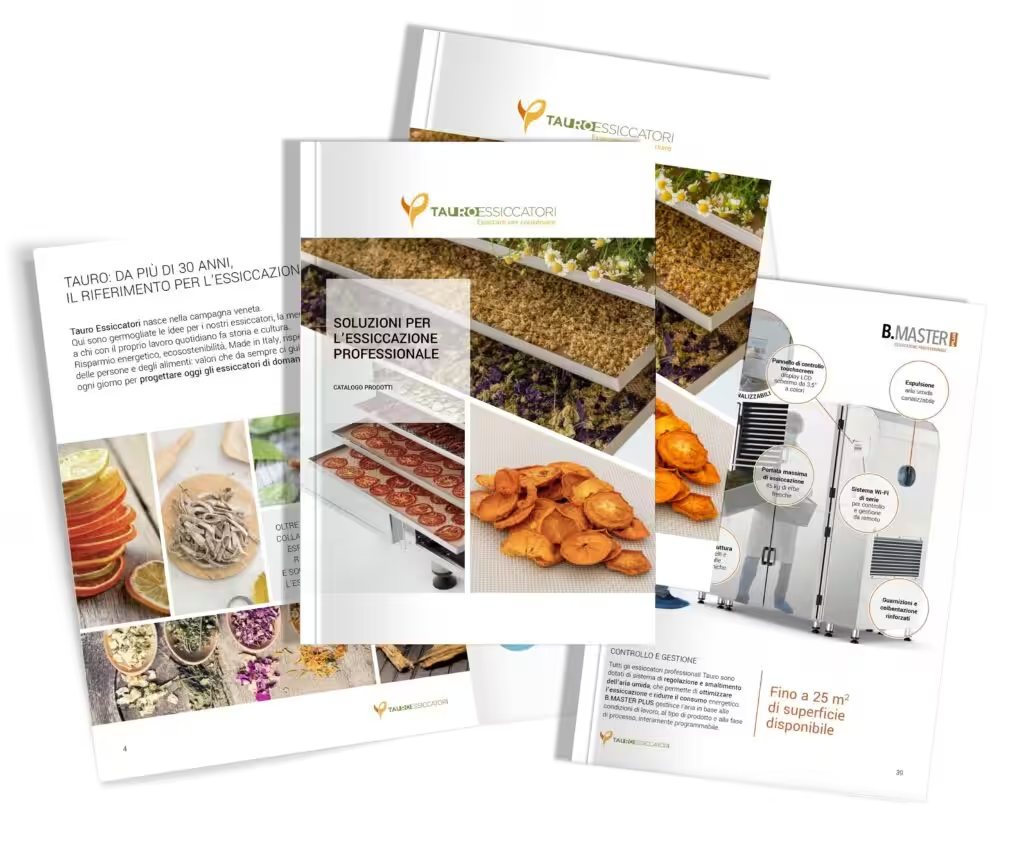
When a dryer enters a laboratory, a farmhouse or a farm, it is not simply adding a function. It is changing the way seasonality, surpluses, product quality and margins are managed. This is why a guide to buying a useful professional dryer cannot stop at the technical data sheet: it must help you understand which machine you really need, with what objectives and what compromises. Conscious drying by Tauro is based precisely on total respect for raw materials, enhancing the work of those who make the land and craftsmanship their business culture.
Anyone who works with fruit, vegetables, herbs, mushrooms, herbal teas, handcrafted preparations or natural pet food knows that the issue is not just about drying. The point is to do it in a uniform, repeatable way that respects the characteristics of the food. Colour, aroma, consistency and cleanliness of the process are what distinguishes a well-dried product from one that is only dehydrated.
Professional dryer buying guide: where to start
The first question is not how many shelves you need, but what kind of production you want to support. It is one thing to process the seasonal surplus of an orchard or vegetable garden to combat food waste and diversify the commercial offer. It is another to work every day on standardised references to sell to shops, restaurants or specialised distribution. Volumes, times, work organisation and even the level of control required over the dehydration process change.
It is therefore worth clarifying four aspects before purchase: average quantities to be processed, frequency of use, type of food and commercial objective. If the end product is to have continuity in yield, the machine must guarantee consistency and millimetre precision. If, on the other hand, the drying process is primarily for enhancing small batches or experimenting in creative cooking, operational flexibility may be more important.
At this stage it is also useful to think about the future. A professional dryer is not bought for this year's harvest, but to accompany lasting production growth. Downsizing the machine soon leads to bottlenecks and forces complex shifts during harvest peaks. Oversizing without a strategy, on the other hand, means tying up resources and misusing energy and space within your workshop.
The heart of the choice: design quality
Among the technical criteria, the most decisive is often the least visible: how the air moves inside the drying chamber. In professional use, correct flow distribution makes the difference between homogenous drying and uneven production, with trays that work well and others that require rotations, continuous checks or corrective times.
The horizontal airflow logic, which has always characterised Tauro systems such as the Biosec line and the B.Master range, is particularly appreciated precisely because it aims to distribute air evenly over each individual shelf. The hot, dry air passes longitudinally through the trays and immediately exits, preventing moisture from stagnating. This helps to process the product more evenly, reducing imbalances between different areas of the machine. For those working on several trays simultaneously, it means less variability, less handling during the cycle and more consistent quality from batch to batch. In addition, the absence of internal mixing of streams means that different foods can be dried at the same time without fragrances and aromas mixing.
Well-designed professional drying must not stress the food. Controlled temperatures and well-managed air movement serve to remove water progressively, while preserving organoleptic properties, natural colours and original aromas. This is especially true for medicinal herbs, herbs, mushrooms, slices of fruit and delicate vegetables that contain thermolabile enzymes and vitamins, which would be irreparably degraded by excessive or uncontrolled heat.
Because uniformity matters more than declared power
Many people, when choosing, immediately focus on watts, maximum temperature or external dimensions. These are very useful data, but on their own they are not enough. A very powerful machine but poorly balanced in air distribution or humid air disposal can give worse results than a well-designed system capable of working with continuity and precision. Excessive power without intelligent management of air recirculation only risks biscuiting the outer surface of the food, trapping moisture in the centre and promoting the subsequent appearance of mould.
In the professional sector, the real question is this: does the dried product come out homogeneous, repeatable and saleable? If the answer is uncertain, the number on the data sheet loses its value. The dryer must become a reliable production tool, not a machine that forces continuous manual adjustments and corrections. Tauro technology offers advanced electronic programmes and advanced Wi-Fi functionality, designed to modulate ventilation and thermal stops according to the real evolution of the process.
Capacity, footprint and work organisation
Capacity should be read in relation to the fresh product, not just the number of shelves. Strawberries, apples, courgettes, porcini mushrooms, herbs and dough to be processed have very different densities, thicknesses and yields. This is why the same machine may seem capacious with some foods and limited with others. For example, a load of fresh herbs will take up a lot of volume but very little weight, requiring the use of dedicated leaf catchers or box baskets, while tomatoes cut in half will have a considerable liquid mass requiring different times and surfaces.
It is worth assessing how much raw material actually goes into a cycle and how much comes out after drying, considering that the average reduction ratio is one to ten. This step is essential for those who have to define pricing, labelling, batch planning and stock availability. An herbal tea professional has different storage and space management needs than someone who processes vegetables or prepares crispy fruit snacks.
The footprint also matters, but not only in terms of space occupied. A professional dryer must fit well into the workflow: preparation and cutting area, tray loading, unloading, product cooling, packaging and cleaning. If the machine is the right size but complicates the operational routine of the laboratory too much, the initial advantage is reduced. To facilitate these operations, the adoption of modular structures and trolleys in AISI 304 stainless steel becomes a crucial competitive factor.
When to choose a bigger machine
It makes sense to move up the range when production is seasonal but intense, or when concrete commercial growth is expected in the short term. In agriculture and artisanal processing, the processing window is often short and extremely concentrated in time. If the machine is too small, a substantial part of the raw material risks deteriorating in the field and not being valorised in time, resulting in a net loss of profit.
Conversely, those working on small premium batches or niche preparations might prefer a smaller capacity, such as that offered by compact but technologically advanced systems that are easier to handle on a daily basis. There is no absolute right size. There is a machine proportionate to the company's project, capable of optimising efficiency without wasting resources.
Temperature control and product types
Fruits, vegetables, herbs, mushrooms and mixed preparations do not always require the same heat treatment. A good guide to buying a professional dryer must therefore consider the accuracy of the thermal control and the stability of the process over time. Accurate electronic control allows you to range from twenty degrees up to the higher temperatures required for specific purposes.
Those who dry herbs and flowers generally seek great delicacy, preferring temperatures not exceeding forty-two degrees, which is useful for safeguarding the fragrance of the petals and the integrity of the essential oils. Those processing watery vegetables or more structured preparations, such as meat or fish for the production of pet food or jerky beef, on the other hand, need more intense cycles, capable of reaching sixty-eight degrees to quickly break down the bacterial load and avoid degradation. Reliable control means being able to build a scientific production method, not going by trial and error.
This aspect is also central for those who want to develop new market references. A professional dryer is not only used to store surpluses: it allows the creation of innovative ingredients, concentrated powders, fruit sheets, healthy snacks, bases for infusions and semi-finished products with high added value. The more the process can be controlled via clear interfaces or remote management systems via Wi-Fi, the easier it is to innovate without losing quality consistency between batches.
Expert's trick
In order to make the most of each drying cycle and avoid any form of waste in their workshop, professionals adopt the recycling kitchen method. When processing vegetables such as carrots, celery or onions, the peels and cleaned apical parts can be dried separately at fifty degrees. Once they are completely dehydrated and free of residual moisture, simply blend them finely with a powerful blender or electric spice grinder to obtain a totally natural, preservative-free and richly flavoured vegetable granular stock cube, perfect for enriching soups and risottos. If, on the other hand, you are working with sugary fruits such as strawberries or very ripe persimmons that do not hold up to slicing, the advice is to blend them into a puree, spread the mixture on non-stick trays and leave to dry at fifty degrees until you obtain an elastic sheet that can be cut into energy bars or pulverised as a sweet topping.
Consumption, timing and real profitability
The purchase price is only part of the overall bill. Over time, electricity consumption, hourly productivity, ease of handling and the percentage of the product that is actually valorised all have an impact. A cheap but structurally unstable or poorly insulated machine can cost much more in terms of lost working hours, food waste, uneven quality and difficulty in standardising processes.
One must therefore look at the real profitability of the investment. If the dryer makes it possible to recover seasonal surpluses, drastically reduce food waste and transform delicate raw material into a stable, light product that can be sold all year round, its value does not coincide at all with the mere initial cost of the machinery. This is especially true for farms, craft workshops and hospitality businesses that want to extend the commercial life of their harvest and improve their margins.
Cycle times must also be read with balance and technical expertise. Seeking maximum speed at all costs is not always the best choice, in fact it often proves counterproductive. In food drying, accelerating the time too much by raising the temperature penalises organoleptic quality, visual appearance and the overall flavour profile. The excellent result always stems from the ideal balance between energy efficiency and respect for the food's natural timing.
Materials, cleaning and service
In the professional sector, the machine has to be designed to last and to be operated with maximum daily convenience. Solid materials such as stainless steel suitable for food contact, reliable electronic components and ease of cleaning affect the smoothness of work every single day. These are no minor details, especially when the dryer is used very frequently and with products with very different organoleptic characteristics.
The availability of qualified technical support also plays a decisive role, clear manuals and training to fully understand the dynamics of the process. A company does not just need to buy a machine. It needs to learn how to use it well, to understand how to adapt it to its specific production, and to be able to count on a competent and available contact person. This is exactly where the experience and proximity of the producer make a real difference in the market.
In a sector where many models look apparently similar, the real value lies in what comes after the purchase: timely assistance, culture of the dehydration process, continuity in the availability of spare parts and the ability to accompany the growth of those who produce. This is a logic that specialised and proudly Made in Italy companies like Tauro Essiccatori have built up over the years, skilfully combining craftsmanship, technological innovation and continuous training.
The most frequent mistakes before buying
The first mistake to avoid is to buy based solely on the lowest price, neglecting construction quality. The second is to choose a volumetric capacity disconnected from your actual working volume, risking undersizing the system. The third mistake, which is extremely common, is neglecting the design of the drying machine and the behaviour of the air inside the machine, an element that directly affects the final quality of the result and the saleability of the product.
Another common mistake is to think that all foods are dried in the same way and at the same time. Those who process different products within the same laboratory need operational flexibility, parameter control and scientific method. Finally, the importance of after-sales service is too often underestimated. When the dryer enters the company's production routine on a permanent basis, it is no longer a simple optional accessory: it becomes an integral and strategic part of the business process.
How to tell if a dryer is really suitable for your business
The correct strategic choice comes when three fundamental elements are put in perfect synergy: absolute quality of drying, sustainability of daily work for operators and economic consistency of the investment. If a machine helps to respect the properties of the raw material, to better organise production batches thanks to intelligent systems and to transform the seasonality in value, then it is a sensible and far-sighted choice.
Professional drying, done with strict criteria, is not a shortcut to save time. It is an ancestral and natural method of preservation that requires attention, profound knowledge of physical processes and technological tools that are up to modern challenges. Precisely for this reason, it can become a concrete marketing and business lever for those who want to work better, reduce waste to zero and offer a product of excellence that truly tells of the quality and passion of its raw material. To find out how you can integrate these technological solutions into your production cycle and get to know the Biosec and B.Master range of systems, we invite you to contact the professionals at Tauro Essiccatori, the Italian benchmark in food dehydration.
 Italian
  English
  German
  Spanish
  French
  Romanian