




Drying by profession: what is really needed
When a harvest is particularly bountiful, a food processing plant faces typical seasonal production peaks or a small farm wishes to deseasonalise its supply, coordinated drying stops being a simple preservation technique and becomes a precise choice of economic model. It is not simply a matter of subtracting fractions of water from fresh food to prevent spoilage. It means governing a physical process to preserve intact the native aromas, original colours, cell structure and commercial value of the raw material, operating in perfect harmony with the rhythms of the earth and according to a concrete logic of reducing food waste.
Food professionals immediately understand this dynamic: not all dehydration processes lead to the same standard. A food treated with professional criteria preserves a clear legibility of the raw material, an intact organoleptic profile and a very high quality perceived by the end consumer. On the contrary, drying conducted in an approximate manner or with inadequate instruments alters the primary aromas, causes evident structural inhomogeneities between pieces and compromises the recognisability of the product, making commercial positioning and the construction of a stable offer over time complex. In professional landscape, the stability of the method determines the success of the finished product.
Drying by profession is not only about preserving
While in the domestic context, natural dehydration is mainly associated with conscious self-production, food well-being and the management of small garden surpluses, in the professional context these elements are complemented by strict operational requirements. These include the continuity of the result over large volumes, the maintenance of a uniform quality standard, the economic sustainability of thermal cycles and the seamless integration of the machinery into the daily workflow.
An agritourism farm finds in drying the ideal tool to valorise the surplus fruit and vegetables of its land, transforming them into stable ingredients for breakfasts, garnishes for gourmet cuisine or exclusive references destined for direct sale in the farm shop. A food processing laboratory can structure dedicated lines of dehydrated vegetables, functional snacks, vegetable crackers or ready-to-use aromatic bases. Similarly, those who cultivate medicinal plants and aromatic herbs require extremely temperature-controlled and gentle treatment, which is indispensable in order not to disperse the more volatile active ingredients and essential oils. Finally, operators in the Horeca sector exploit dehydration technology to optimise stock storage, reduce volumes in the pantry and have toppings and ingredients ready at any time of the year.
In each of these scenarios, operating methodically means transforming a highly perishable fresh matrix into a stable food at room temperature, easily manageable in logistics and capable of generating a higher economic margin. This virtuous circle can only be realised, however, if the technology employed deeply respects the physical and chemical characteristics of the food.
Quality is about air, not just temperature
A common misconception is that drying is a direct consequence of the heat supplied. In the physics of this process, the real deciding factor is the correct management and distribution of the air flow. If the air carrier does not flow evenly through the drying chamber, unavoidable thermal imbalances occur within the same batch, with trays showing partially moist products at the core and other trays where the food is excessively dry or biscuity. This inhomogeneity forces the staff into continuous manual checks and defeats the replicability of the cycle.
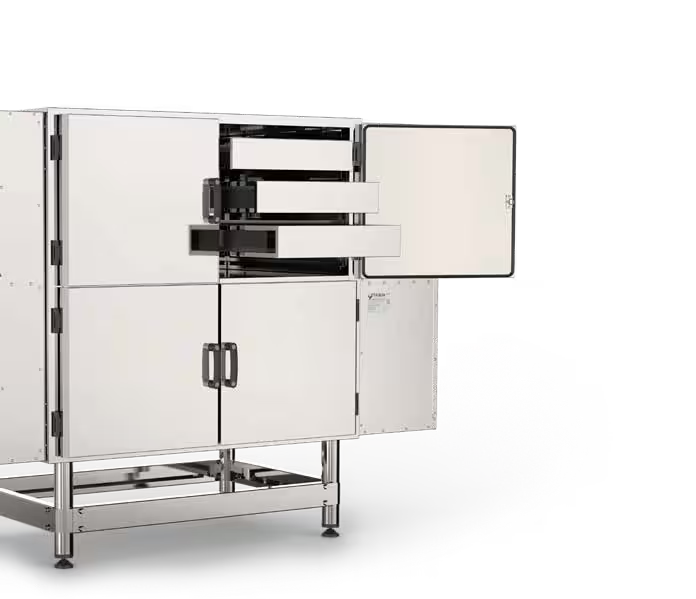
For a professional use, the uniformity of moisture removal is not a secondary detail, but the fundamental precondition for planning work shifts, estimating cycle times and guaranteeing a consistent product on the market. The unidirectional horizontal airflow technology, developed by Tauro Dryers and integrated in both the Biosec line and the semi-industrial and professional B.Master series, is designed to solve this problem at its root. The hot, dry air flows longitudinally through each shelf independently, touching the food above and below with equal intensity and evacuating the saturated moisture directly to the outside, with no stagnation or mixing of scents between different drawers.
When the flow is precisely calibrated, evaporation and disposal of water from plant tissue occurs naturally and smoothly, preserving the cell structure without causing hardening of the outer cuticle. This technological rigour is valid for fruit slices, kitchen vegetables, wild mushrooms and the delicate leaves of medicinal herbs: the objective of a professional system is not speed for its own sake, but to obtain a perfect, natural and repeatable result over time, reducing the energy required for operation.
What changes in a business
The adoption of perfectly uniform drying drastically reduces downtime dedicated to visual and manual inspection of batches, eliminates the need for piece sorting at the end of the cycle and simplifies automated or manual packaging operations. For those in charge of marketing, this technical stability translates into absolute reliability for distributors, incumbent retailers and end customers. For those managing production, it means operating in a predictable environment, where batches of raw material are valued without operational contingencies.
Which products are suitable for professional use
Drying applied to business expresses its full potential when it is part of a defined commercial strategy and applied to raw materials selected at source. It is not enough to consider the dryer as an emergency tool to manage surpluses; it is necessary to assess how the dehydrated product can respond to market demands while maintaining a high gastronomic interest and a clear sensory identity.
Fruit represents one of the most profitable and immediate areas of application. When harvested at the perfect degree of sugar ripeness and dehydrated correctly, they are transformed into healthy snacks for early childhood, stable ingredients for artisanal pastries or components for gourmet cereal mixes. Dried vegetables find an ideal place in the preparation of dehydrated soups, ready-made condiments for fast food, traditional sauces and food powders pure. A separate chapter is made up of aromatic and medicinal herbs, where the delicacy of the thermal cycle is vital: the quality of the finished product is linked to the ability to maintain the original vivid colours and the concentration of stable essential oils, avoiding the oxidation processes that darken the leaf and wipe out its fragrance.
In recent years, the following have developed commercial niches of great interest, such as the craft production of natural pet food, which uses drying at controlled temperatures to obtain chews and snacks of meat or fish free of chemical preservatives. Many laboratories also work on the formulation of dehydrated ready meals or on the valorisation of agricultural cutting waste. In each of these segments, the quality of the process is evident in the visual and tactile test: colour tones consistent with fresh, no surface burns and a perfectly dry and stable internal structure.
The real issue: productivity or quality?
The choice of the ideal dehydration system is often set around a false dilemma, where productivity is pitted against the quality of the organoleptic result. A modern professional system must be designed to merge these two aspects, guaranteeing maximum protection of the raw material even on high industrial volumes.
As highlighted in the professional dryers catalogue, operational requirements vary considerably depending on the company's business model. A small farm that has to absorb seasonal harvest peaks needs flexibility and immediacy of use, requirements that are met by compact machines such as the Biosec Pro, equipped with 12 AISI 304 stainless steel shelves and a usable area of 3 square metres. When volumes of fresh raw material become important, laboratories and processors must turn to insulated modular systems such as the B.Master series. This line makes it possible to scale up production from the 14 square metres of the Base model to the 50 square metres of the B.Master Plus Twin XL version, equipped with 144 shelves and dual thermo-ventilating units up to 15 kW, fully prepared for Industry 4.0 logic thanks to remote control via Wi-Fi and digital traceability of production batches.
For this reason, the choice of dryer must be made by analysing the real efficiency of the structural air flow and the thermal stability of the machine, not simply the nominal capacity. In a professional context, a system is effective if it optimises structural energy consumption, facilitates daily cleaning operations and limits maintenance costs. If a machine forces operators to continually make adjustments, the cost generated is not only energy-related, but also reflects negatively on the organisation of work.
Drying by profession requires method
A common mistake is to think that professional and industrial scale drying is a simple volumetric extension of empirical methods applied in domestic kitchens. Operating on a market requires the development of a rigorous and standardised method. The initial preparation of the raw material determines to a large extent the quality of the final batch: the execution of a regular cut of equal thickness, the correct arrangement of the pieces on the shelves without overlapping and the careful selection of the degree of ripeness of the fruit are essential steps to ensure simultaneous water evaporation.
Equally crucial is the management of the phase following the end of the ventilation cycle. A perfectly dehydrated food leaves the plant at a high temperature; if it is packaged or stored incorrectly, it runs the risk of instantly reabsorbing the moisture present in the ambient air, compromising the structural fragrance and opening the way for mould to develop. The staff's attention must remain constant throughout the internal supply chain, from receipt of fresh produce to final storage in sealed containers.
The professionals who achieve the best results on the market structure a rigid and documented operating routine. Production batches are precisely defined, cycle times are recorded in relation to the external ambient humidity, standardised visual and tactile checks are carried out and strict quality control criteria are applied to the finished product. This systematic approach protects the company, reduces operational variables and simplifies the possible expansion of the product range and processing volumes.
Training and technical culture make the difference
The presence of excellent equipment in the laboratory is not enough to guarantee commercial success if it is not supported by solid technical expertise and in-depth knowledge of food matrices. For this reason, access to in-depth technical content, detailed user manuals and the’direct assistance from the manufacturer represents a fundamental strategic value for the company.
Understanding the variables at play - such as the combination of different temperatures for set time intervals or the alternation between fan speed and pause times - transforms drying from an intuitive practice to a scientific business skill. For many operators, the quantum leap is realised at this very moment: to stop considering dehydration as an occasional recovery solution and to include it fully among the core processes of production. When this vision is adopted, yields increase, quality standards stabilise and the ability to tell the value of the product to the end consumer is refined.
Made in Italy, short supply chain and the fight against waste
Drying with professional criteria takes on a profound cultural and social significance, closely linked to the enhancement of the land and environmental sustainability. It means respecting the integrity of the agricultural raw material, extending its commercial life without resorting to the addition of chemical additives or artificial preservatives, creating stable products that tell the story of a territory, the work of the fields and respect for seasonality. In a global market often characterised by standardised foods, artisanal identity constitutes an extraordinary competitive distinguishing factor.
For the Italian entrepreneurial fabric, natural drying represents a concrete tool to consolidate short supply chain and circular economy models. This technology makes it possible to recover field surpluses at peak production times, valorise out-of-size or aesthetically unsuitable fruit for direct fresh sales, and structure shelf-stable product lines throughout the year. This is not a purely technical choice, but a conscious processing philosophy, attentive to safeguarding resources and in perfect harmony with the great Made in Italy gastronomic tradition.
Against this backdrop, Tauro Essiccatori's mission has been developed for over thirty years around a precise idea: to conceive drying not as an aggressive heat treatment that distorts the food, but as a natural and controlled method, focused on maximum protection of the real quality of the finished product and constant support for those who cultivate and process the land.
When it really pays to start
The incorporation of this technology within a business is advisable when one has a reliable quality raw material, has a clear understanding of the business outlets and is willing to think in terms of a standardised process, abandoning random or empirical attempts. It is not necessary to start large plants immediately; the priority is to set up work with absolute methodological clarity.
For some farms, the primary objective lies in zero field waste and recovery of cultivation costs. For other artisanal structures, the priority is to expand the commercial range or increase the perceived value of their brand through exclusive gourmet proposals. Whatever the starting point, the evaluation criterion remains the same: professional drying is effective when it improves business efficiency, optimises the sustainability of daily work and strengthens the company's competitiveness on the market.
Those who choose to tread this path with care and rigour quickly discover that dehydration technology offers much more than simply preserving food. It makes it possible to give a stable, clean and recognisable form to everything the earth has to offer, season after season.
Expert's trick: the perfect crispy effect and professional recycling cooking
To increase farm profitability by reducing biological waste to zero, processors can apply recycling kitchen methods to create pure artisanal flavourings with high added value. The clean skins of tomatoes, the roots and outer leaves of onions and leeks, or the fibrous stalks of asparagus can be spread on non-stick PTFE Drysilk sheets and thoroughly dehydrated to a crisp, crystalline structure. Once finely ground in a powerful blender, these elements are transformed into stable aromatic flours, pure flavouring powders for risottos and velvety soups, or excellent bases for the formulation of homemade granulated vegetable stock cubes free of chemical additives, capable of commercially valorising one hundred per cent of the original raw material.
If you want to optimise the operational processes of your workshop, eliminate waste from your agricultural harvest or find out which professional horizontal flow drying system perfectly meets the structural needs of your business, we invite you to connect with the world of Tauro Dryers. Discover the versatility of the Biosec Pro systems and the technological efficiency of the B.Master industrial range, and join the our professional community to transform the wealth of nature into a stable, sustainable and proudly Made in Italy store of value.
 Italian
  English
  German
  Spanish
  French
  Romanian