




How to dry thin courgettes properly
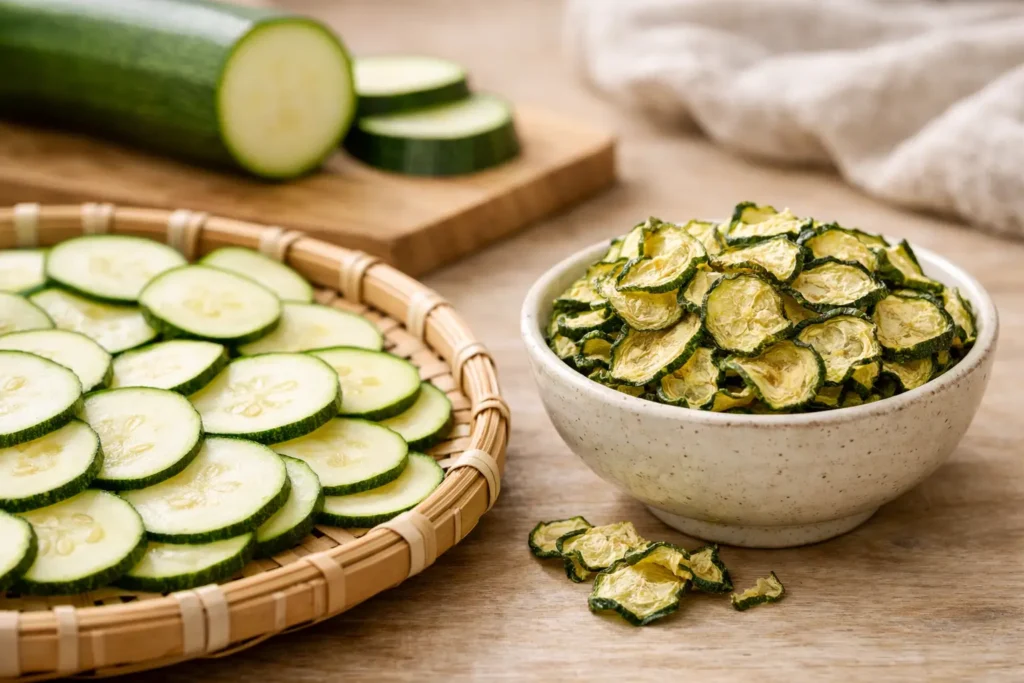
If the fresh courgettes They are plentiful in fields and vegetable gardens during the summer; the key point is not simply to find a way to store them, but to do so with a focus on absolute quality. Understanding how to dry thin courgettes means achieving a product that is light, fragrant, uniform and structurally suitable for use in culinary preparations all year round, avoiding ending up with soggy slices that have darkened due to oxidation or have been dehydrated unevenly.
Due to their biological nature, courgettes contain an extremely high percentage of water – often exceeding ninety per cent of their total mass – and have very delicate flesh. Precisely because of this specific physical composition, they require meticulous care during two crucial stages of the processing: cutting and the management of airflows within the drying tunnel. When the thickness is calibrated to the millimetre and the airflow operates constantly and parallel to the trays, the result changes profoundly, both in terms of visual appeal and the consistency of the final quality of the preserved product.
How to dry thin courgettes without any problems
To dry thin courgettes whilst minimising technical errors, it is essential to start with a rigorous selection of the raw produce. It is necessary to choose healthy, organic courgettes harvested at the perfect stage of ripeness. Courgettes that are too large or harvested too late contain excessive amounts of free water, have spongy flesh and a large number of seeds inside, which tend to collapse during processing, resulting in uneven drying. The ideal choice is young courgettes that feel firm to the touch, with unbroken skin and firm flesh.
Even the initial washing stage must follow specific guidelines to avoid adding further external moisture. It is sufficient to rinse the fruit briefly under running water, dry it thoroughly with a clean tea towel and trim the ends neatly. Peeling the vegetables is not recommended: the outer skin, if tender and free from chemical treatments, acts as a natural exoskeleton that helps the slice retain its geometric shape during water loss, whilst preserving its bright green colour and a significant portion of the vegetable’s flavour and vitamin content. Only when working with large courgettes, characterised by a skin that has become leathery, should partial removal be considered.
The real technical challenge of the whole process lies in ensuring a consistent thickness. When slicing thin slices, every single piece must be exactly the same height. If, within the same basket, there are slices that are almost transparent alongside others several millimetres thick, evaporation will proceed at different rates: the former will dry out prematurely, becoming brittle and heating up unnecessarily, whilst the latter will retain a moist and unstable centre. In the context of mindful home production, consistent cutting is the most reliable way to achieve uniform crispness or structural flexibility without microbiological risks.
The right cut makes all the difference
Courgettes are remarkably versatile and can be sliced into perfect rounds, half-moons or thin strips lengthways. Each shape alters the product’s macroscopic behaviour during the removal of water. Thin rounds are extremely practical to handle, easy to arrange on shelves without overlapping, and offer immediate versatility for everyday cooking. Cutting into lengthwise strips, on the other hand, proves useful when a more elastic and structured end product is desired, ideal for complex preparations that require stuffing, rolling or seasoning at a later stage.
The pursuit of uniformity in cutting is not merely an aesthetic requirement, but a specific fluid-dynamic necessity. Inside a professional-grade or advanced domestic dryer, the airflow must encounter a uniform surface in order to remove moisture symmetrically. If the raw material has structural defects and varying thicknesses, the action of the ventilation system will never be able to fully compensate for the initial preparation error. For this reason, the use of a mandolin When properly adjusted and fitted with sharp blades, it offers a significantly higher standard of precision than a cut made manually and in a hurry with a knife.
Arranging the slices on the trays requires the same precision. The courgette rounds or strips must never be overlapped or piled on top of one another. They can be placed very close together, almost touching, but always leaving the channels free so that air can circulate and envelop the food from both above and below. In a controlled natural drying system, the correct movement of air is the only real driving force behind the gradual migration of water out of the vegetable, without altering or stressing the cellular structure.
Temperature and weather: the importance of balance
Those approaching food dehydration for the first time often ask for a strict table setting out an exact number of hours and minutes. In the practical reality of the drying process, however, the total duration of the cycle depends on a matrix of interrelated variables: the botanical variety of the courgette, its initial water content, the thickness of the slices in millimetres, the total volume of product placed in the tunnel, and the relative humidity present in the environment on that specific day. For this reason, it is technically incorrect to specify a single, universal time.
When preparing courgettes, it is best to use moderate temperatures, ideally between 45 and 50 degrees Celsius. Cooking at gentle temperatures allows the vegetable to lose moisture gradually, preserving its natural enzymes, flavours and colours.
In systems featuring a strictly horizontal, unidirectional airflow, such as the operating principle of the Biosec range The major technical advantage of Tauro Essiccatori’s systems lies in the perfectly symmetrical distribution of hot air across all shelves. The air enters at one end of the tunnel and exits at the opposite end, simultaneously circulating through every basket. This eliminates the need to constantly reverse the position of the trays during the cycle and ensures consistent control of the process. This is a crucial factor when dealing with delicate, thinly sliced vegetables, where the millimetre-precise ventilation determines the quality of the final result.
How to tell when they’re ready
Properly dried courgettes should not contain any trace of moisture. If, when bending a slice, it feels soft, if the slice releases microscopic droplets, or if the centre feels colder to the touch than the edges, this means that the process of evaporating the free water is not yet complete and the product needs to remain in the tunnel for longer. The optimal point of completion is determined by the product’s intended culinary use.
If the aim is to create healthy snacks or vegetable crisps to be eaten as they are, the texture should be completely dry, crumbly and crunchy. If, on the other hand, the courgettes are intended for use in sauces, soups, purées or fillings to be cooked, a slightly softer and more gelatinous texture is also acceptable, provided it is perfectly stable and free from biologically active water. The final check must always be carried out only after the product has cooled completely. When the slice is still hot on leaving the dryer, the tissues and natural sugars are softened by the heat, resulting in a softness that disappears as soon as the food stabilises thermally.
The most common mistakes when drying thin courgettes
The first mistake to avoid is cutting the courgettes unevenly, which results in slices of varying thicknesses within the same batch. The second mistake is overloading the baskets, creating barriers of produce that obstruct the flow of air. The third mistake stems from the urge to switch off the machine prematurely. Courgettes do not tolerate careless handling: their high water content reacts quickly to poor ventilation, resulting in changes in colour and stability.
Another very common technical mistake is to sprinkle salt on the slices before starting the drying process, without any real culinary justification. Salt acts by altering the osmotic pressure of the plant cells, drawing water outwards rapidly and creating a sticky, liquid film on the surface of the slice. This layer significantly slows down natural evaporation and alters the final texture, making the product hygroscopic and prone to reabsorbing ambient moisture in the pantry. To obtain a neutral, versatile product with a long shelf life, it is best to dry the vegetable in its purest form, leaving any seasoning until the moment of consumption or rehydration.
There is also widespread debate regarding the pre-blanching of courgettes. Although this method of heat treatment is appropriate for other types of harder or more fibrous vegetables, in the case of thinly sliced courgettes it is almost always counterproductive. This brief exposure to boiling water destroys the crisp texture of the flesh, damages the delicate cell walls and causes a significant proportion of the minerals and water-soluble vitamins to leach into the cooking water. In the context of informed home or professional preparation, starting the process with the fresh, raw product, treated only with a skilful cut, is the cleanest and most efficient solution.
The expert’s tip: versatile aromatic salt and anti-waste powder
If, whilst slicing with a mandoline, you end up with irregular pieces, ends or imperfect slices that don’t meet the required thinness, don’t make the mistake of treating them as waste to be thrown away. Collect these small pieces and spread them out on a dehydrator tray lined with a non-stick mesh or with the Drysilk sheets, leaving them to dry thoroughly alongside the main batch until they become completely hard and crumbly. Once the cycle is complete and the product has stabilised, place these irregular pieces into a powerful blender or a electric spice grinder along with some coarse sea salt and a few dried mint or thyme leaves. Blend thoroughly to create an exceptional aromatic courgette salt, perfect for adding a touch of summer to your winter dishes. Alternatively, you can grind the dried courgettes on their own to produce a very fine vegetable flour, ideal as a natural thickener and flavouring for sauces, purées or homemade bread and fresh pasta doughs.
Storage and use in the kitchen
Once the drying process is complete, the thin courgette slices must be placed immediately into their final storage containers. Sealing the slices inside a jar whilst they are still warm will prevent them from partially rehydrating due to ambient humidity. Storage requires clean glass jars fitted with airtight lids and kept in places protected from direct light, heat sources and high humidity.
At this stage, the technical integrity of the drying process becomes clear: if the product has not been completely stripped of all its free water, no type of container will be able to prevent it from spoiling. Conversely, when the product is perfectly dried, storage becomes a safe, straightforward process that ensures the product remains fresh for many months.
In the kitchen, having thinly sliced dried courgettes on hand offers immense practical and creative value. They can be added directly to soups, minestrone or vegetable broths, where they will reabsorb the cooking liquid in a matter of minutes whilst retaining their full flavour. They can be briefly rehydrated in lukewarm water to serve as a filling for traditional omelettes, savoury tarts or homemade flans. In the case of crispy chips, the benefit is immediate: the seasonality of the produce is fully enhanced, and a surplus harvest is transformed into a ready-to-eat snack that is healthy and free from artificial preservatives.
When is it best to dry very thin courgettes, and when isn’t it?
Opting for a cut designed to achieve an ultra-thin thickness proves to be the right choice when aiming for the fastest possible dehydration cycle, immediate crispness for direct consumption as crisps, or the subsequent reduction of the product into a fine powder. However, this cut is not the ideal solution for every culinary scenario. If your ultimate aim is to rehydrate the vegetable to use it as the star ingredient in a pasta dish or a stew, a slice that is too thin will tend to lose too much texture on the plate. In such cases, a slightly thicker cut, between six and eight millimetres, will offer a much more satisfying texture and a far greater culinary experience.
This type of structural design takes on even greater importance in a professional context. In the processing facility of a farm, a farm holiday business or a small artisanal processing unit, the choice of cut geometry must be planned in advance, in close correlation with the desired commercial output. Whether it is a ready-to-sell snack, an ingredient for dehydrated vegetable mixes or a base for sauces, proper drying does not simply mean removing water from the food, but designing with absolute precision the behaviour of the finished product over time.
How to dry thin courgettes in a really handy way
The fundamental question to ask goes beyond the practicalities of how to dry thin courgettes; it extends to the underlying reasons for this choice and the quality standards one intends to uphold. If the real aim is to reduce food waste, genuinely make the most of the earth’s produce, preserve natural flavours and colours without the use of chemical additives, and create a smart pantry, then it becomes essential to apply a rigorous method that can be repeated over time.
A drying process carried out with due care shows deep respect for agricultural work and restores dignity to a seasonal foodstuff that is all too often undervalued or handled carelessly at the height of the harvest. This is not a passing trend towards self-sufficiency, but a solid, age-old technique for processing and preserving food. When the process is guided by technology that respects the food, the courgette’s original identity remains perfectly discernible to the senses: the nature of the vegetable, its characteristic aroma, its natural colour and its integrity are all clearly recognisable.
It is precisely in this detail that the clear distinction lies between simply drying food and drying it to the highest standards. In the first case, one merely removes the water in a haphazard, disorderly manner that is often detrimental to the nutritional components. In the second case, following the Tauro method, the food is guided towards a natural, lasting stabilisation that is consistent with its original quality. It is from this meticulous care that the best result emerges: not from the haste of cooking, but from the skilful balance of air.
To find out more about the correct methods of dehydration and discover Tauro’s technology, we invite you to explore the solutions in our home drying range and our professional systems here on the official Tauro Essiccatori website.
 Italian
  English
  German
  Spanish
  French
  Romanian