




How much does a dryer really consume?
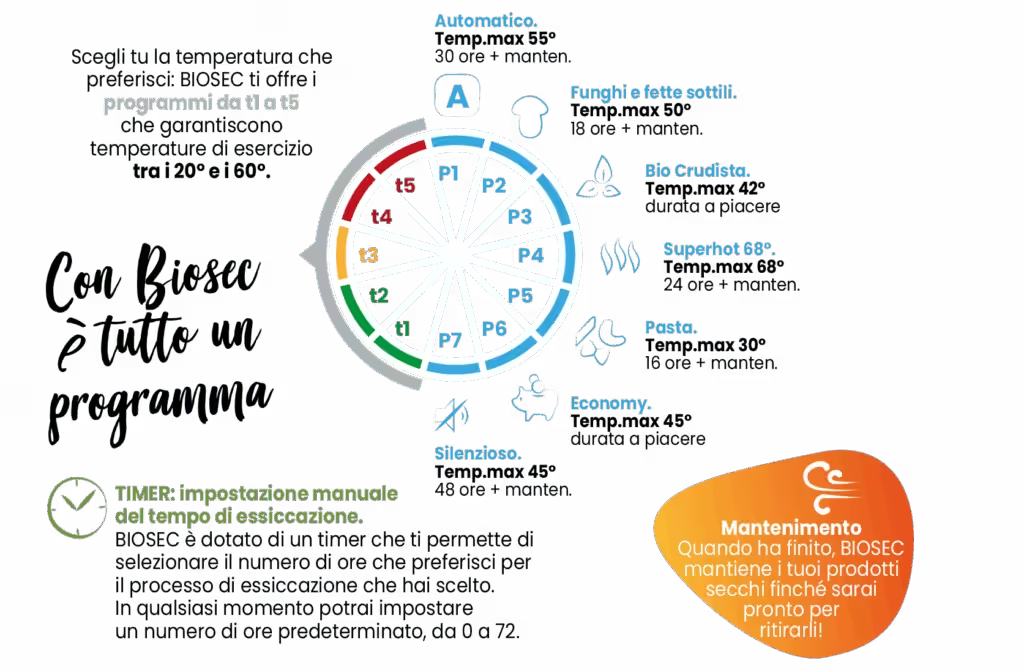
The question often arises after the first start-up, when the dryer starts working for several hours and the thought immediately runs to the utility bill. Figuring out how much a dryer consumes is a useful awareness exercise, but it must be done with technical criteria: it is not only the number of hours that counts, but above all the technology with which the machine handles the power and the desired result.
A Tauro dryer is not an oven. While the oven works by heat accumulation at high temperatures, the dryer works in a gradual manner, using flows of hot air to remove water without cooking the food. This approach preserves the organoleptic properties and makes the actual consumption much lower than one might imagine.
How much does a dryer consume in practice
To analyse energy consumption, we must start with the rated power, expressed in watts. This figure indicates the maximum energy the machine can absorb. A domestic dryer, such as the models in the Biosec line, has a maximum power of approximately 550W, while the systems in the B.Master series for professional use have higher power ratings to handle larger load volumes.
Actual electricity consumption is measured in kilowatt-hours (kWh). If a machine constantly absorbed 500 watts, it would consume 0.5 kWh every hour. In 10 hours, the theoretical consumption would be 5 kWh. However, thanks to the DrySet Pro electronic control, the heating element is not always running at full power: once the set temperature is reached, the system only works to maintain it, thus significantly reducing consumption.
Let us take a concrete example based on an average tariff of 0.25 euro per kWh. If a 500W dryer works for 10 hours, the theoretical maximum cost would be around 1.25 euros. In reality, taking into account the switching on and off cycles of the heating element, the final cost is often lower, making drying one of the cheapest and most sustainable conservation methods.
What does real consumption depend on
The answer to the question “how much does a dryer consume” is inevitably: it depends. Several factors influence the efficiency of the process:
- Type of food: very watery products such as tomatoes, peaches or citrus fruits take longer than mushrooms or herbs.
- Thickness of cut: uniform, thin slices (approx. 5-7 mm) facilitate the rapid evaporation of moisture.
- Loading the baskets: arranging the products without overlapping them allows air to circulate freely, optimising time.
- Ambient temperature: a warm, dry environment will help the machine reach operating temperature faster than a damp cellar.
A crucial role is played by the quality of construction. Tauro's horizontal flow system ensures that the air hits all racks simultaneously and evenly. This avoids having to reverse the shelves manually and ensures that no corner of the machine remains damp, eliminating wasted time and energy.
The Expert's Trick
To maximise efficiency and reduce consumption, start the dryer while you are still slicing the products. Insert the baskets as they are ready: the hot air will immediately start working on the surface, preventing oxidation and reducing the total time spent in the machine.
Domestic dryer and consumption: an investment in value
In the domestic sphere, the fear of long cycles (12 or 24 hours) is often an error of perspective. The dryer should not be compared to a blender used for a few seconds, but to the value of the raw material it is saving.
Drying means turning garden surpluses or seasonal purchases into stocks that will last for more than a year. It means eliminating preservatives, additives and plastic packaging from your diet. The cost of a few cents of electricity is more than compensated for by the savings on the purchase of industrially processed products and the fight against food waste. For many families, Biosec is not just an appliance, but a pillar of conscious household organisation.
The calculation for your bill
For those who want mathematical precision, the formula is simple: (Watts / 1000) x Hours of operation x Cost per kWh = Total expenditure.
If you use a 550W model for a 12-hour cycle with a tariff of 0.30 euro/kWh, the calculation will be: (550 / 1000) x 12 x 0.30 = 1.98 euro.
Remember that this is the maximum cost; the intelligent Tauro electronics will reduce this value by managing the power according to the real thermal need of the moment.
For professionals: efficiency beyond wattage
In a laboratory or a small craft production, the issue of consumption is closely linked to profitability. A professional machine must guarantee absolute uniformity: if the airflow is not perfect, some products will remain damp, forcing rework or, worse, causing mould in the finished batch.
The B.Master series is designed precisely to maximise the output per kW consumed. The thermal insulation and automated management of humid air disposal allow the highest quality standards to be maintained, reducing operating costs and increasing the commercial value of the end product.
Is it really worth using a dryer?
If we look only at the meter, consumption is comparable to that of other commonly used appliances, but with a much more diluted impact over time. If we look at the quality of life, the convenience is indisputable.
The dryer suits those seeking food autonomy, those who love natural flavours and those who want to regain the rhythms of nature. It is not just a machine that consumes electricity; it is a tool that preserves aromas, colours and nutrients, offering the freedom to eat healthily all year round.
Discover the complete range and find the perfect model for your needs on the official website Tauro Dryers.
 Italian
  English
  German
  Spanish
  French
  Romanian