




Pasta dryers: how to choose the right one
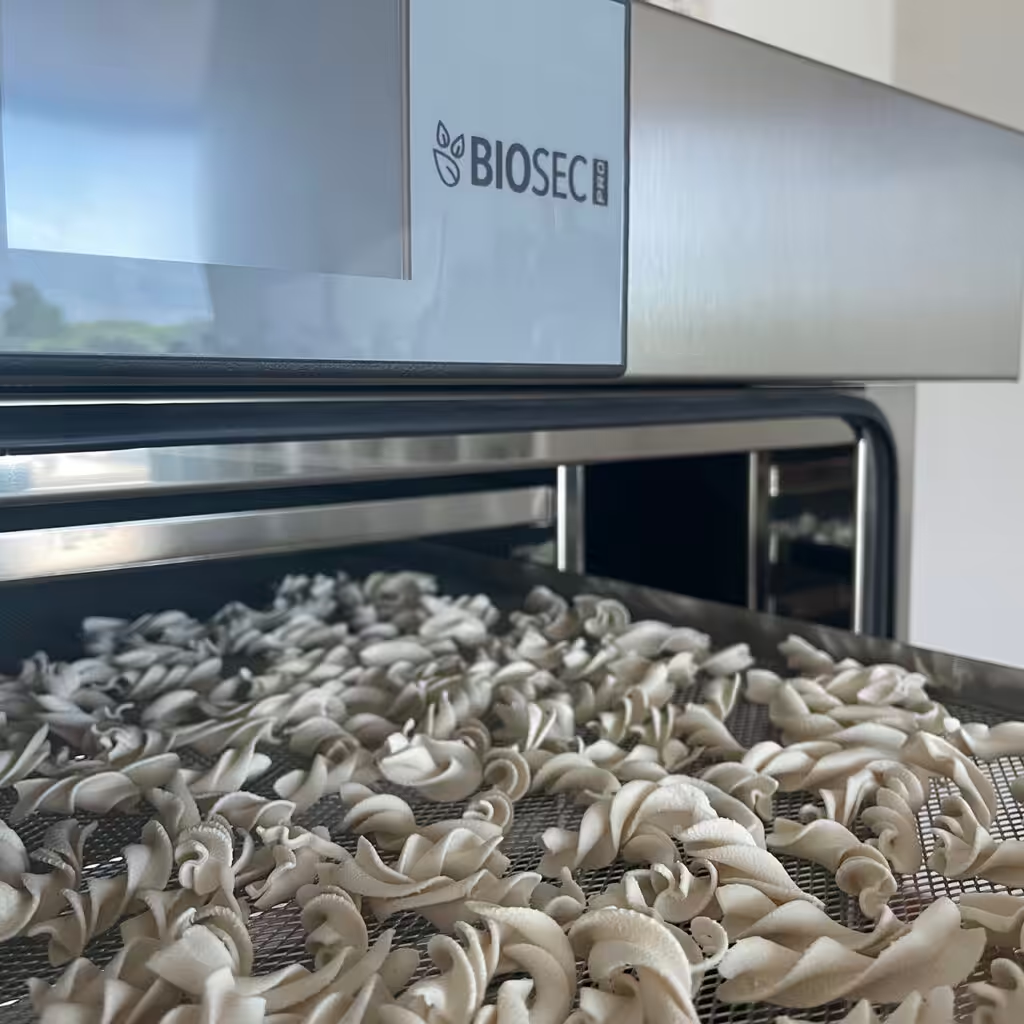
When it comes to homemade pasta or artisanal products, the skill involved in rolling out the dough and the choice of semolina are merely the first step in a complex process. Often, the real critical point – the one that determines the stability and success of the final product – comes in the hours following shaping: the drying and dehydration phase. A professional pasta dryer, when selected with rigour and scientific criteria, ceases to be a mere accessory and becomes the operational heart of the laboratory, ensuring a stable, uniform end product that preserves the value of the initial work intact.
Anyone who makes fresh pasta for their own family, for a farm-stay’s menu, for an artisan pasta factory or for a local micro-producer knows full well that the transition from fresh to dried pasta is not a straightforward process that can be left to chance. This heat treatment has a direct impact on long-term shelf life, structural integrity during boiling, and the visual presentation in retail outlets. Dehydration carried out incorrectly or too rapidly risks damaging the surface of the pasta shape. Conversely, weak or uneven drying creates a dangerous imbalance: the pasta appears ready and dry on the outside, but retains a treacherous percentage of residual moisture deep within its core, compromising the stability and food safety of the batch.
Why use a pasta dryer?
Leaving pasta to dry in the open air on traditional wooden and mesh frames is a custom deeply rooted in tradition, which retains its historical significance in very small family-run operations, provided the climate remains consistently favourable, dry and free from sudden temperature changes. However, when the focus shifts to consistency of results, strict hygiene and health standards, and the predictability of production cycles, relying entirely on environmental weather conditions becomes an unsustainable constraint for both the enthusiast and the professional.
The use of a controlled artificial drying system allows work to be planned with mathematical precision. Strict management of airflows and temperatures allows the evaporation of free water to be controlled with absolute precision, eliminating the uncertainty associated with changing seasons or humidity levels in the workplace. This systematic control is important in domestic settings to avoid wasting raw materials, but it plays a vital role in professional settings, where every single batch placed on the market must strictly meet perfectly replicable quality, visual and shelf-life standards.
In addition to purely logistical and storage considerations, there is a key factor relating to sensory quality. Natural, gradual drying is not solely intended for long-term preservation. Its primary purpose is to preserve the gluten structure, the flour’s original colour and the pasta’s primary flavour profile. This value becomes evident when choosing to work with selected durum wheat semolina, ancient grain flours, whole grains or special doughs enriched with dehydrated ingredients, vegetables, spices or seaweed. Only a carefully calibrated water removal process, free from aggressive temperature spikes, prevents the denaturation of proteins and the degradation of natural pigments, keeping the aromas of the wheat and the colours of the earth alive.
What really matters when making a choice
There are various types of food dehydration equipment available on the market, but it is essential to understand that not all technological designs are suitable for processing a product as delicate and complex as pasta. The optimal choice should not be based solely on an assessment of power consumption or a simple calculation of tray surface area, but on the physical principle governing how air moves within the drying chamber.
Horizontal airflow makes all the difference
When it comes to drying homemade or professionally made pasta, the drying process is the key factor that separates a perfect result from a defective product. The cheapest and most basic systems on the market use vertical or unidirectional airflows from below, which, upon encountering the first loaded trays, quickly become saturated with moisture, slowing down or preventing proper evaporation in the upper trays and forcing people to carry out continuous and laborious manual rotation of the trays to avoid mould or uneven drying.
In contrast, the horizontal airflow technology – which has always been a cornerstone of Tauro Essiccatori’s design – flows over every single tray in a perfectly parallel, uniform and bidirectional manner. The hot, dry air flows through the chamber, enveloping the pasta above and below the basket with the same intensity and speed. This ensures that the entire load reaches the stopping point at exactly the same moment, eliminating internal moisture gradients and preventing the mixing of aromas. Thanks to this principle, it is possible to optimise space to the full by loading different sizes or batches without the risk of aromas overlapping inside the tunnel.
Temperature control and humidity balance
From a structural point of view, pasta is a living organism: the starch and proteins form an elastic network that reacts to changes in temperature and humidity. Exposing the dough to excessive or unregulated heat causes the outer layer of the pasta to harden immediately. This phenomenon blocks the natural migration of water from the centre of the pasta to the outside, trapping internal moisture and, over time, generating structural stresses that result in visible cracks and systematic breakage.
In artisanal production, the go-to tool for managing this complexity is the system Biosec Pro, specifically designed to provide users with industrial-grade technological solutions. This machine controls temperature profiles with millimetre precision and is equipped with the Smart Dry system, an advanced technological package that maintains constant communication between the food and the drying chamber. Using integrated humidity sensors, the Biosec Pro automatically regulates the opening and closing of the exhaust valves: when the internal air becomes excessively saturated, the system expels the moisture; when it detects the need to even out the dehydration process to prevent surface crusting, the chamber closes temporarily to redistribute the steam across the surface of the pasta, allowing the vegetable fibres and starches to rest and enabling the internal water to migrate outwards in a completely gradual manner, free from mechanical stress.
Capacity should be considered in relation to actual usage
A common misjudgement in business or domestic planning is to choose a machine that is too small in order to save on the initial investment, or, conversely, one that is far too large for the actual daily dough mixing and shaping capacity. In the first scenario, this creates an unsustainable logistical bottleneck, forcing the fresh pasta to wait on the racks and triggering oxidation processes before it enters the chamber. In the second case, there is a waste of thermal energy, as large volumes of air are moved for partial loads.
For a pasta factory, Whether it’s a small-scale farm, an artisan workshop or a farm stay, the starting point must be an analysis of the batch sizes and weekly production frequencies. The modularity of Tauro’s professional systems allows you to tailor the usable space to your actual needs, adding trolleys or additional modules only when market demand and sales volumes require it, whilst always ensuring the facility’s maximum energy and cost efficiency.
Short, long or filled pasta: they’re not all the same
Examining the drying of pasta in general terms can be misleading, as each individual shape responds differently to the physical laws of evaporation. The thickness of the sheet, the shape of the pasta and the presence of fats or animal proteins, as in the case of egg pasta, determine the product’s inherent resistance to water loss.
Short pasta shapes such as penne, fusilli or handmade orecchiette can be easily arranged on the AISI 304 stainless steel shelves, but they require careful spreading to avoid excessive clumping or corner overlaps, which would slow down the horizontal flow. Long pasta, such as tagliatelle, spaghetti alla chitarra or fettuccine, requires space to be managed using hand-formed pasta nests or by spreading the pasta out on frames, taking care to ensure that the points of contact between overlapping strands do not create damp clumps that are difficult to dry.
Stuffed pasta, such as ravioli, tortelli or agnolotti, falls into a category of extreme technical complexity. In this case, we are dealing with the coexistence of two elements with opposing moisture levels and thermal responses: the outer pastry, which tends to dry out quickly, and the inner filling, which is often moist, high in fat and highly perishable. In this context, the static dryer requires strict hygiene and safety protocols and specific drying curves to prevent bacterial growth within the filling, demonstrating that the design and scientific understanding of the equipment are far more effective than any improvised solution.
For manufacturers, profitability is also important
In an artisan bakery or a farm that chooses to process its own durum or soft wheat directly, the dryer ceases to be merely a kitchen appliance and becomes a crucial factor in profit margins and economic competitiveness. This system allows for the restructuring of working hours, freeing up the immediate sale of fresh produce and enabling the accumulation of stable stocks of dried pasta to be placed on the market during peak periods of tourist or commercial demand.
When the thermal process is controlled by reliable and repeatable technology, the rate of waste due to breakage, cracking or spoiled batches is reduced to virtually zero. This control protects the company’s gross operating margin and strengthens the brand’s reputation in the market. A customer buying artisanal dry pasta demands a product that retains its shape, maintains the same texture from the first to the last piece in the pack, and does not break up during cooking, releasing starch into the water. Investing in a specialised system means choosing the financial stability of your artisanal business.
Success stories in craftsmanship: the micro-workshop
The validity of this integrated approach is clearly demonstrated by the experiences of those who have turned mindful drying into a sustainable and profitable business model. A prime example is La schiscéta Homemade cooking, a micro-workshop specialising in artisanal home cooking (IAD) located in Ameno, in the province of Novara, and run by Federica Mora.
What began as a simple need to find a natural and efficient way to preserve the abundance of seasonal produce from her own local vegetable garden has since undergone a significant technical evolution. After taking its first steps with low-cost vertical-flow equipment, which had obvious structural limitations in terms of consistency and processing times, Federica made a significant leap in operational quality by adopting Tauro’s horizontal technology, which is now the very heart of her production line.
In his workshop, the fresh, artisanal pasta is enhanced and enriched by the addition of dehydrated vegetable powders, seasonal vegetables, spirulina and stone-ground ancient grains. Alongside the pasta, the Tauro system is used to produce courgette crisps spread out on non-stick trays, 100% pure vegetable stock cubes made from recycled peelings, flavoured salts and a selection of medicinal herbs. With no traditional physical shop, this micro-enterprise distributes its products through selected local markets, direct orders and digital channels such as Instagram and Facebook, demonstrating how the flexibility and precision of a professional drying system enable even small-scale operations to establish themselves in the market with unique, healthy and high-value-added products.
Common mistakes to avoid
The first mistake lies in treating pasta with the same lack of care one might apply to foods that are less complex in structure. Pasta requires a steady increase in temperature; rushing the process by turning up the heat without taking relative humidity into account destroys the starch bonds.
The second mistake is overcrowding the trays inside the chamber. Piling the pasta on top of one another or creating multiple layers with no space between them physically prevents the horizontal airflow from reaching the sides of the pasta. This creates shadowed areas where water stagnates, triggering acidification or creating cracks invisible to the naked eye, which will result in the product breaking apart systematically as soon as it is immersed in boiling water.
The third mistake is failing to check the actual level of deep-drying before packing the pasta into retail bags. Hot or warm pasta removed from the dryer is always naturally pliable due to the heat, which temporarily softens the starch structures.
The Tauro expert's trick
To ensure absolute certainty when assessing the process and guaranteeing perfect results, Tauro’s technicians and experts recommend monitoring the behaviour of the dough by following this precise empirical checklist:
- If the pasta breaks or cracks during the cycle inside the dryer: the process is too aggressive and surface evaporation is occurring too quickly compared to the rate at which the internal water is migrating. Solution: slow down the cycle immediately by reducing the temperature and increasing the relative humidity in the chamber.
- If the pasta appears intact but breaks within a few hours, during packaging or storage, this means that the product was removed from the machine too early. The core still contained free water which, migrating outwards once the chamber was switched off, altered the volumes, generating delayed stresses. Solution: extend the deep-drying cycle times.
- If the pasta breaks or falls apart noticeably whilst cooking in the pan, the problem lies in the initial stage of the production process. Solution: make a slight adjustment to the dough’s hydration or to the extrusion and shaping parameters.
- If you notice any irregularities when tasting the pasta: make it a strict rule to always taste a raw and a cooked sample from every single batch produced, checking the texture of the gluten network right through to the centre of the pasta.
How to tell if a model is really suitable
Before purchasing a professional or industrial pasta dryer, it is essential to ensure that three key design and operational requirements are met. The first is the absolute uniformity of the parallel airflow, which must circulate over the trays without creating any stagnant zones. The second is the accuracy of the chamber’s electronic control systems, capable of operating with stable preset programmes or customisable curves. The third element, often underestimated, is the depth of the support and training ecosystem offered by the manufacturer.
Drying is a practical science that requires experience, but having access right from the start to accurate guidance based on scientific studies and comprehensive manuals saves valuable time and raw materials. A specialist partner that designs and manufactures its own systems in Italy, with an in-depth understanding of the biochemical behaviour of food, offers value that goes far beyond simply selling the machine. Tauro Essiccatori has built its reputation precisely on this inseparable combination: cutting-edge mechanical technology, a deep understanding of food processing, and ongoing support for the customer over time.
The home pasta dryer
The introduction of a horizontal dehydrator into the home reflects a clear commitment to conscious consumption. Those who choose to make their own pasta at home wish to regain full control over the ingredients, select organic flours or local grains, make the most of seasonal vegetables incorporated into the dough, and drastically reduce their reliance on standardised products from large-scale retailers.
A good domestic dehydrator turns this philosophy into a sustainable and rewarding daily routine. It allows you to concentrate your food preparation on those days of the week when you have more free time, creating healthy, long-lasting stocks ready to be stored in the pantry in simple glass jars with screw-top lids. The protected environment of the drying chamber shields the pasta from dust, winter humidity fluctuations or high summer humidity levels, allowing you to explore new recipes and special shapes with complete peace of mind and the certainty of a perfect result.
A technical choice, but also a cultural one
Choosing a Tauro drying system means taking a step that combines technical precision with a deep respect for Italian culinary culture. Pasta is not just any food: it represents the identity of regions, family traditions and artisanal skills handed down through generations. Processing this raw material requires technology that does not compromise the product, but gently guides it towards lasting stability.
Drying carried out in accordance with Tauro’s natural parameters preserves the delicate aroma of the wheat, maintains the structural integrity of the pasta shape, and promotes a circular and mindful approach to cooking, aimed at eliminating waste and making the most of agricultural resources. This value remains unchanged whether you cook at home once a week or are building the commercial success of your professional kitchen around absolute quality.
The ideal machine is not one that promises miraculous shortcuts or instant drying times that defy the laws of physics. It is a system capable of offering millimetre-level precision, operational continuity, structural robustness and absolute respect for the food. It is from this perfect engineering balance that an artisanal dry pasta of excellence is born, capable of telling the story of its land and the value of its method on the plate.
If you would like to understand how to incorporate horizontal drying into your business, optimise drying curves for your special formats, or discover the technological efficiency of the system Biosec Pro, We invite you to explore the professional solutions on our official website and consult the detailed guides on how easy our software is to use. Turn your passion into a certified quality process.
 Italian
  English
  German
  Spanish
  French
  Romanian