




Farm dryer: how to choose it
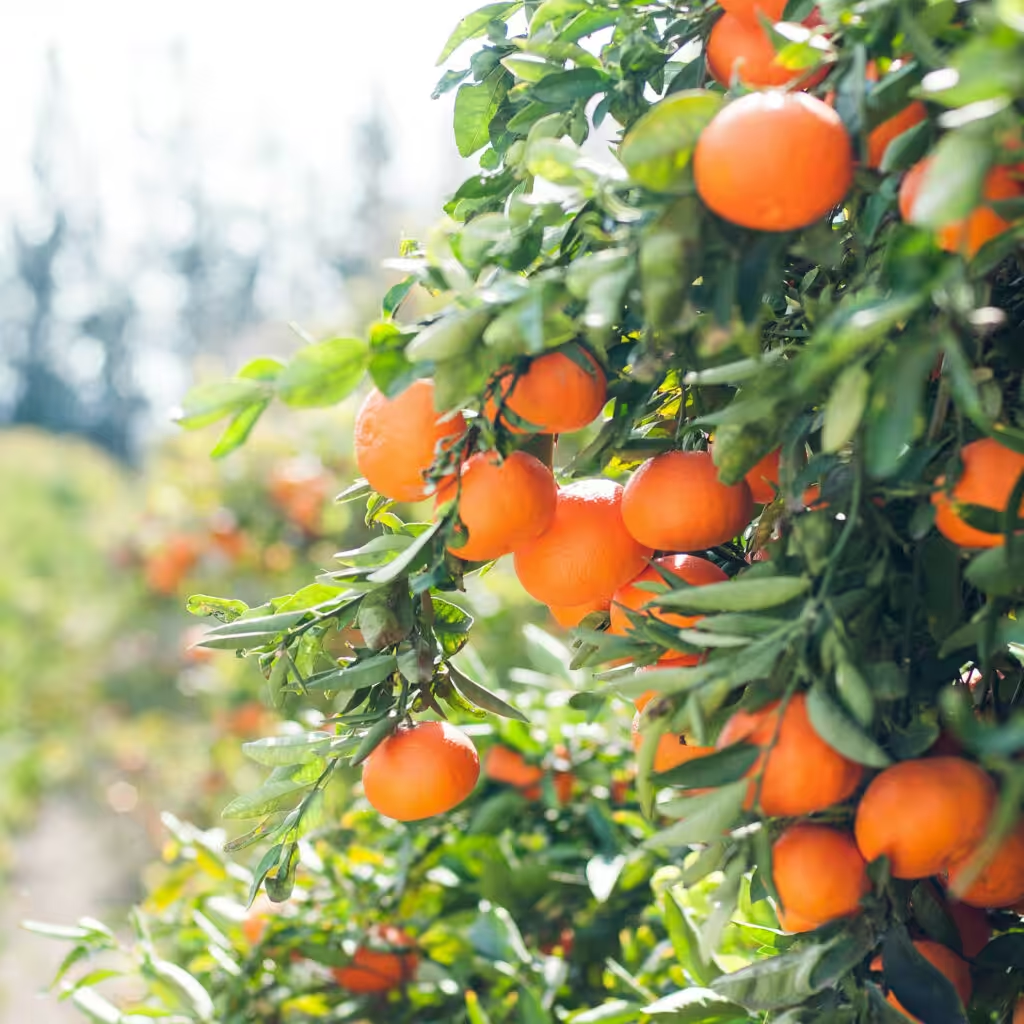
When the harvest arrives all at once, time ceases to be a detail and becomes the critical success factor. Fruits, vegetables, aromatic herbs and mushrooms have a very narrow useful window; in this context, a farm dryer can make the difference between a raw material that is enhanced and a share of the product that loses quality, price or sales possibilities. This is why the choice should not be approached as a simple equipment purchase, but as a strategic production decision that directly impacts the business model.
Drying, in agricultural sector, It serves not only to conserve. It serves to give continuity to seasonal work, to reduce waste, to differentiate supply and to build products with a greater identity. But the results depend on the method, the technology used and above all the consistency between what is produced in the field and what you want to bring to market. Choosing a horizontal airflow system, like the one developed by Tauro, means guaranteeing uniformity of treatment on every single shelf, preserving the integrity of the product from the first to the last tray.
What a farm dryer is really for
Many people begin to evaluate drying when they are faced with surplus production or batches unsuitable for fresh sale due to aesthetic defects. This is an understandable but reductive starting point. A good plant is not just a tool to recover the surplus: it is a lever to transform the harvest into a stable, programmable product line with a profit margin that is often more attractive than fresh.
Think of apples, figs, tomatoes, courgettes, onions, peppers, herbs or small fruits. Sold fresh, they suffer the pressures of seasonality, perishability and logistics. Properly dried, they can instead enter value-added packaging, herbal tea blends, catering ingredients, processed for farm shops, farmers' markets, e-commerce or high-end professional supplies.
However, this only applies if the final quality is up to the expectations of professionals. Dull colour, uneven drying, lost aromas or irregular textures compromise the perception of the product. This is why choosing the’right dryer means protecting the value of agricultural labour, keeping the original organoleptic properties and nutrients almost intact through meticulous control of ventilation and heat.
The technical criteria that count when choosing
A professional (non-industrial) dryer for a farm should be evaluated on a number of technical factors: useful drying area in square metres, uniformity of air flow, precision in temperature control, cycle times and ease of sanitisation.
Capacity is important, but it alone does not describe real productivity. It matters how much fresh raw material actually goes into processing, with what thickness of cut, on how many shelves and with what final yield. A company that processes 100 kg of apples does not reason in the same way as one that dries small batches of delicate herbs. In the first case, structure, continuity and a constant air exchange are needed to handle the high humidity output. In the second, millimetric precision on temperature can be decisive in order not to burn the essential oils and preserve the natural colour of the leaves.
Thermal control is also central. Each food item has its own balance point between time, temperature and final quality. If the machine works in an approximate manner, perhaps with vertical air flows that force the operator to continuously invert the trays, the risk is twofold: either the time is extended too much, saturating production, or it is accelerated too much with aggressive temperatures, penalising fragrance, colour and sensory properties. Tauro's horizontal flow technology was developed precisely to eliminate these critical issues, ensuring that each tray receives the same amount of air at the same temperature.
Uniformity and air management
Air distribution is a point often underestimated by less experienced manufacturers. In professional processes, the difference between a well-designed drying process and a mediocre one is seen in the regularity of the result. If some trays dry sooner and others remain moist, the operator has to intervene manually frequently, accepting a level of variability that, in the long run, weighs on operating costs and the company's reputation for quality. A professional drying system, on the other hand, must guarantee autonomy and predictability of the work cycle.
Dimensioning: finding the balance between volume and flexibility
Buying an undersized dryer quickly leads to unsustainable bottlenecks. During the peak of the season, when the product in the field presses to be harvested, the machine works non-stop, times become compressed, staff chase batches and there is a risk of selecting product not on the basis of quality, but solely on the urgency of freeing up space. This is a frequent situation in companies that start with hobby equipment hoping to sustain a real production line.
On the other hand, oversizing also has its limits if it is not accompanied by modular technology. A system that is too large in relation to the actual volumes can be energy inefficient. If the company processes very different seasonal products, or wants to test new references in small batches, it needs a machine that maintains excellent performance even when not loaded to capacity. Tauro's B.Master line, for example, offers the versatility needed to scale up production while maintaining maximum energy efficiency.
The correct question is not just how many kilos you want to dry in total, but how much floor space you need in the critical weeks, with what frequency of loading and with what ultimate commercial goal. Serious and profitable sizing is born from this analysis. At Tauro, we have the experience and professionalism to help farms choose the right professional dryer.
Consumption, time and work optimisation
The purchase price is a given, but the real cost is measured over time and can be read in the folds of day-to-day management. A dryer affects the electricity bill, the organisation of the warehouse and the man-hours required for preparation, loading, monitoring and packaging. A machine that is cheap to purchase, but inefficient in airflow, can become the heaviest cost in the year-end budget.
An efficient system must help the farm work better, not just produce more. If technology reduces the need for manual intervention and allows programmable cycles (as with the programmes installed in Tauro's digital systems in the B.Master professional lines), it allows staff work and deliveries to be planned with extreme precision. This is vital for businesses that integrate processing with direct sales or agro-tourism, where time is the scarcest resource.
Sanitation and Made in Italy materials
The issue of cleanliness must also be considered. The use of AISI 304 stainless steel for the shelves and materials certified for food contact is not an optional extra, but a requirement for safety and durability. Easy-to-sanit surfaces and components designed to withstand heavy workloads save valuable time every day. When the season is at its peak, every minute saved in maintenance is a minute gained in productivity.
Which products to dry and with which commercial strategy
Not all agricultural products respond in the same way to drying. Some have very different weight yields; usually the ratio is 1:10, i.e. from 10 kg of fresh you get 1 kg of dry. This is why technological investment should always be accompanied by reflection on market positioning.
Aromatic and medicinal herbs occupy little volume, have fast drying times and can generate lines of high perceived value if treated at very low temperatures so as not to disperse fragrances. Fruit offers incredible opportunities for healthy snacks, but requires pinpoint attention to the thickness of the cut and management of natural oxidation. Dried vegetables, when reduced to powder, become natural dice or flavour enhancers that modern catering seeks with extreme care to avoid chemical additives and glutamate.
Drying does not reward improvisation. It rewards those who know their harvest well and decide to standardise the production process. An artisanal product must maintain its identity and link with the land, but it must also guarantee the consistency of quality needed to stay on the market with seriousness and authority.
The importance of specialised technical support and expertise
A professional dryer should not be considered just a hot box. It is a precision technology that performs best when supported by expertise: in the design phase, in the choice of software parameters and in end-user training. This wealth of knowledge is often ignored at the time of purchase, only to be desperately sought after at the first difficulty.
For a farm, having an experienced partner is essential. It means being able to count on someone who knows the yields, the criticalities of different feeds and how to organise batches to optimise production. It means having a reliable reference in the transition from the experimental phase to continuous production.
This is where the difference between a generic supplier and a specialist how Tauro Essiccatori fully manifests itself. A brand with over 30 years of Made in Italy history does not just supply a machine, but provides technical and human assets to transform an entrepreneurial idea into a concrete, solid and repeatable process.
Expert's trick: the importance of horizontal flow and loading
To maximise the efficiency of your professional dryer, remember that the secret is not only in the temperature. With a Tauro horizontal flow system, you can load all shelves without leaving gaps between product slices. Since the air does not have to pass through the product from below, but instead grazes it from the side, you will never have the “plug” effect typical of vertical dryers. This allows you to utilise the 100%'s available floor space without ever having to rotate the trays during the cycle, saving hours of manual labour.
When the dryer becomes a corporate identity statement
Then there is an intangible but extremely powerful aspect. The farm that chooses to dry well is communicating a precise way of being on the market. It is declaring that the harvest deserves time, care and a processing that respects its nature. It is consciously choosing not to sell off the surplus and not to consider waste as an inevitable fate, but as a resource to be ennobled.
This value is now clearly perceived by the conscious consumer, specialised shops and the catering industry that is attentive to the short supply chain. To be credible, however, this promise must be based on impeccable quality. A good Tauro dried product is immediately recognisable: it has the intense fragrance of the fresh product, maintains a vibrant and natural colour, has a clean structure and tells of the expertise of those who produced it even before reading the label.
Choosing the right dryer does not mean chasing the biggest or the cheapest machine. It means finding the correct balance between production volumes, commercial objectives and harvest quality. When this consistency is achieved, drying ceases to be an emergency solution and becomes the pillar of a modern, sustainable agricultural project.
Those who work the land know that the value does not only come from what you produce, but from how you accompany that fruit to the hands of the person who will enjoy it. A well-chosen dryer serves exactly this purpose: to give dignity, continuity and a new perspective to the fruit of one's daily efforts.
We invite you to discover how Tauro technology can support the growth of your farm, taking processing quality to the next level. Contact our experts for a tailor-made consultation and find the perfect solution for your production needs.
 Italian
  English
  German
  Spanish
  French
  Romanian