




Dryer for small producers: how to choose it
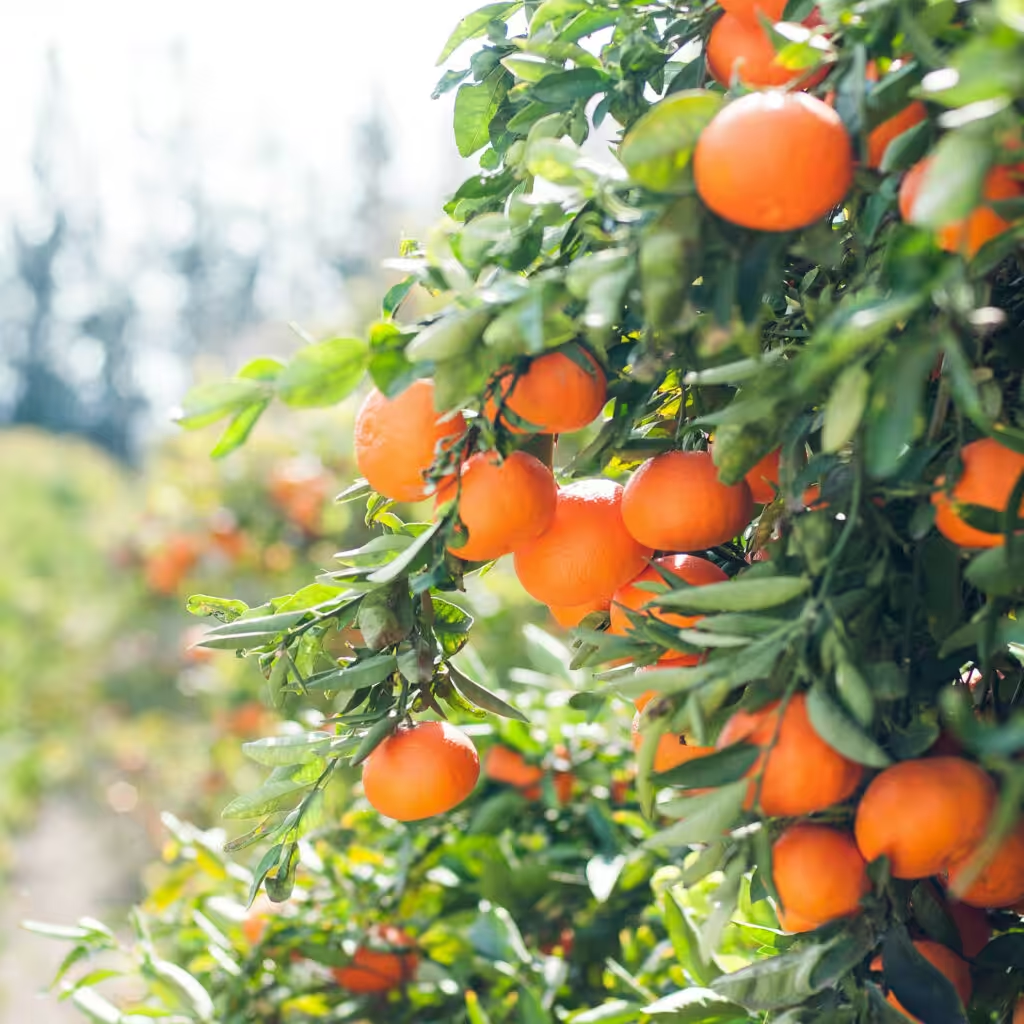
When the farm harvest becomes generous or the processing workshop starts working on small batches on a regular basis, improvisation ceases to be a useful strategy. A dryer intended for professionals and small-scale producers does not have the simple task of removing water from foodstuffs; its true value lies in its ability to transform seasonal surpluses into stable products, with attention to detail, ready for sale and perfectly consistent with the prestige of its name. L’professional drying, approached with scientific and artisanal criteria, represents a real evolution in the management of the short supply chain.
For this reason, the choice of the ideal machine should never be based solely on the purchase price, but rather on the specific type of production. Those who process aromatic and medicinal herbs have profoundly different technical requirements than those who process apples, mushrooms, highly hydrated vegetables, edible flowers or mixtures for infusions and herbal teas. Those who produce for direct sale on the farm, for an agrotourism, for artisanal processing or for small-scale organised distribution must set their reasoning not only on the final visual result, but also on cycle times, process repeatability and overall optimisation of daily work.
What a dryer for small producers is really for
For those running a micro-business or a farm, drying is first and foremost a strategic lever for the economic valorisation of raw materials. This traditional method of preservation makes it possible to extend the useful life of the product, actively combat food wastage at peak production times, and guarantee a constant commercial continuity to references that would otherwise remain rigidly tied to a few days or weeks of seasonality.
There is also a crucial factor that lies in the organoleptic identity of the processed product. A drying process governed with scientific precision allows the native aromas, original colours and the most delicate nutritional properties of the raw material to be preserved intact. This element becomes discriminating when working with high quality fruit, medicinal plants, short chain vegetables or noble ingredients destined for gastronomic preparations with a high value perceived by the end consumer. When the water is removed in a balanced manner, the characteristics of the plant cell are not distorted and the natural flavours are harmoniously concentrated.
In current practice, a professional-level dryer enters the production flow as a genuine primary processing equipment, abandoning the definition of a simple kitchen accessory. If the equipment expresses high technical efficiency, it simplifies the entire work routine; if, on the contrary, it is undersized or designed without the correct criteria, it ends up generating bottlenecks, uneven results between the different shelves and a heavy loss of working hours.
The first criterion is continuity of production
The fundamental question to be asked in the planning phase is not only how much raw material you intend to process, but how often you intend to start cycles. Two distinct realities may find themselves handling the same volumes of product on a weekly basis, yet have diametrically opposed operational requirements. Those who concentrate their activity in a few days of intensive, seasonal harvesting need large loading capacity and absolute thermal regularity. Those, on the other hand, who distribute production throughout the year on small but continuous batches must turn to instruments that make electronic control, programme flexibility and daily reliability their strong points.
A rather frequent error of judgement is to choose a machine based on one's minimum requirements calculated in the short term. Although this may appear to be a prudent decision from an initial economic point of view, in the medium term this choice forces operators into continuous loading and unloading operations, prolongs overall operating times and makes the handling of peaks related to soil and climate complex.
This does not imply the need to systematically oversize the equipment, but it does require finding the perfect balance between the actual volume of raw material, the physical space available in the laboratory and the work pace of the team. An efficient small producer does not look for the largest machine in an absolute sense, but for equipment that is consistent with the fluidity of its processing scheme.
Horizontal airflow: why it makes a difference
When the superior quality of the dehydrated foodstuff is the key objective, the air distribution system inside the tunnel plays a pivotal role. The horizontal air flow allows a perfectly uniform and parallel passage through all available shelves, guaranteeing total homogeneity of the end result. Translated into everyday operation, this means eliminating at the root any drying differences between the product positioned at the top of the tunnel, in the centre or in the lower baskets.
For professional dryers, this uniformity of treatment is not a minor detail. It drastically reduces time lost in having to constantly move or reverse trays during the cycle, simplifies HACCP control procedures and contributes to standardised and consistent commercial batches. Whether producing apple slices, courgette slices, dried tomatoes, herbs or porcini mushrooms, the quality difference is evident in both the retention of the original colour and the final textural consistency.
The logic of horizontal air flow is the only one capable of responding to criteria of scientific rigour and industrial repeatability. It is the same basic principle for promoting natural, electronically controlled drying that is oriented towards absolute respect for the raw material rather than mere forced dehydration speed.
Temperature, time and gentleness of the product
Each food matrix requires a dedicated and specific heat treatment. Aromatic herbs and medicinal plants require mild temperatures and constant ventilation to prevent the dispersion of the fragrances and volatile active ingredients stored in their essential oils. Fruits and vegetables with a high water content require longer cycles and different evaporation dynamics depending on the thickness of the cut, the degree of sugar ripeness and the permeability of the peel. Mushrooms, for their part, require careful thermal management to avert the risk of softening and achieve perfect stability over time.
For these reasons, a dryer intended for small producers must incorporate a reliable and fine control system for the operating parameters. It is not enough to generate heat inside a chamber; a balanced combination of operating temperature, ventilation speed and duration of the active phase is required. An overly aggressive process can lock moisture into the core of the product and alter its colour and aroma. Conversely, a cycle that is too weak risks extending the time beyond the limits of economic efficiency or leaving residual moisture dangerous for storage in the pantry.
In the context of artisan (as opposed to industrial) work oriented towards excellence, the delicacy of processing should not be confused with slowness as an end in itself. It is the technical ability to accompany the food towards microbiological stability while respecting its biological and enzymatic value. Maintaining temperatures below 42 degrees in programmes dedicated to crudists allows, for example, the preservation of all the live enzymes present in fresh food.
Materials, hygiene and ease of handling
Anyone producing food for direct sale or serving to the public needs machinery that offers simple, fast cleaning protocols that comply with current hygiene regulations. The baskets, internal drying chamber, thermoventilation modules and any surface that comes into direct contact with the airflow must allow for easy routine maintenance, eliminating downtime and the risk of cross-contamination.
Design ergonomics also play a major role. Loading the raw material, visually monitoring the shelves and the final unloading must be practical and natural gestures, especially when the dryer is used in a continuous cycle. An awkward geometric configuration or one that is difficult to sanitise, although valid on paper, inevitably ends up weighing on the efficiency and running costs of the laboratory.
In the context of small-scale production, time is the most critical and valuable resource. If a piece of equipment requires constant manual corrections, emergency checks or laborious cleaning of individual components, it ends up diverting precious human energies away from other activities that are fundamental to the company's success, such as field collection, strategic packaging, marketing and taking care of the commercial relationship with the end customer.
Consumption: the figure should be read in conjunction with yield
The subject of energy efficiency must occupy a central place in the evaluation of an investment, but the nominal consumption figure must be interpreted with an overall view. Dwell solely on the energy peak declared on the data sheet can mislead the operator. The real parameter to be analysed is the final balance between the total energy used, the actual quantity of stabilised product and the product quality obtained at the end of the cycle.
A machine with a non-optimised air treatment system may require more hours to complete dehydration or generate commercial waste due to uneven results, forcing a repeat of part of the work cycle with an obvious economic burden. In contrast, a critically engineered dryer with structural insulation and electronic flow management can offer a perfect balance between real power consumption, operating time and overall commercial yield.
For artisanal companies operating with defined profit margins, the real cost of equipment does not end with the figure on the bill. It includes the rejection rate of the raw material, the microbiological stability of the packaged product over the long term, and the ability to maintain a constant quality standard that builds market loyalty. Advanced electronics protect the economic sustainability of the business.
Which productions benefit most
The introduction of professional drying offers very interesting business prospects for multifunctional farms, small food laboratories, agrotourism establishments and local processors wishing to expand their range of references without disrupting brand identity. The production of pure dehydrated fruit, dried vegetables for the professional kitchen, excellent herbs, preparations for artisanal herbal teas, stable mushrooms, edible flowers for confectionery and concentrated powders represents a natural and profitable outlet.
This method is also a structured response to the problems arising from the cyclical overproduction of land. An abundant harvest of plums, apricots, apples or tomatoes can quickly turn into a logistical and financial problem if the fresh raw material is not released onto the market very quickly. Through a well-organised drying process, the same agricultural surplus is removed from the risk of spoilage and transformed into a product with a high shelf-life, which is easy to store, light to transport and highly valuable in terms of price per kilo.
However, it should be considered that not all vegetable matrices guarantee the same profit margins. It is therefore essential to conduct real field trials, assessing preparation times, ideal sizes and energy costs specific to one's own production context. The right technology is the indispensable support, but final profitability always stems from the combination of technical precision and a solid commercial positioning project.
How to choose a small producer dryer without getting the wrong perspective
The purchase of the ideal dryer for your processing workshop should be guided by an analysis of five exquisitely practical questions. - What is the actual volume of fresh raw material that needs to enter the machine during peak harvest weeks? - Which food varieties will be processed most frequently in the facility? - How many staff hours can be allocated to the visual inspection of the ongoing process? - And, above all other considerations, will drying represent a supplementary and occasional activity or a stable and strategic production line for the brand?
If the answer coincides with the development of a stable business line, it becomes imperative to move towards construction solutions designed to guarantee maximum durability, consistent performance and structural solidity. Factors such as the reliability of components, the availability of a assistance direct technical, process-specific training and consistency of plant design become priority selection elements, as well as the declared nominal load capacity.
For these reasons, many agro-food craft businesses choose to turn to manufacturing partners who possess a profound knowledge of drying understood as a biological and physical process, and not as a simple commercial product category. In a professional sector where the difference on the market is played out on the precision of ventilation, thermal homogeneity and strict respect for the organoleptic properties of foodstuffs, Italian design experience expresses a concrete and measurable value. It is precisely on the basis of this rigour of construction that Tauro Essiccatori has been able to consolidate a reputation of absolute authority among professionals who demand Made in Italy solutions expressly geared to the superior quality of food and the operational continuity of laboratory work.
The point is not to dry more, but to dry better
For a small artisanal producer, every single batch placed on the market has the task of telling a story of care, respect for the earth and methodological rigour. A perfectly executed drying process preserves the authentic character of the raw material, supports the economy of seasonality and lends extreme authority to the brand's commercial proposal. It is a choice that invests the sphere of technical expertise, certainly, but which also expresses a profound cultural value and respect for the environment.
Before proceeding to define a technological investment, it is advisable to look beyond the simple numerical data on a catalogue data sheet. The ideal machine is the ally that allows you to work day after day in total serenity, with full respect for the integrity of the food and with a clear long-term vision. When this perfect marriage of man and technology is achieved, drying abandons its role as an emergency solution for seasonal peaks and becomes a healthy, profitable and profoundly sustainable component of the entire business economy.
The expert's trick: optimise cutting and make the most of scraps
In professional processing, precision is the key secret to optimising time and eliminating hidden costs. For fruit and vegetables with a compact pulp such as apples, pears, courgettes or aubergines, the ideal cut must be a constant thickness of between 5 and 7 millimetres. A cut that is too thin would cause the dried product to lose structure, making it fragile during packaging; an excessive thickness would prolong the drying time beyond the efficiency limits of the cycle, increasing electricity consumption.
In order to prevent browning and the natural phenomena of enzymatic oxidation without resorting to chemical additives or sulphites, the expert recommends starting the dryer before even starting the cutting operations. The prepared baskets should be placed in the tunnel individually as they are completed. In this way, the pulp exposed to the air is immediately hit by the warm, dry horizontal air flow, which blocks the action of enzymes and preserves the brilliance of the natural colours.
Finally, with a view to a true circular economy, processing waste such as clean onion skins, celery stalks, leek apical parts or tomato peels should never be considered waste. Collected on dedicated shelves and fitted with reusable Teflon non-stick sheets, these elements can be dried completely to a crystalline consistency. Once finely ground using a powerful blender, they are transformed into concentrated aromatic powders or pure vegetable stock cubes self-produced at zero kilometres, perfect to be marketed as high-margin natural flavour enhancers or used to enrich the farmhouse offer.
Would you like to raise the quality of your food processing and discover how to optimise your company's surplus management thanks to the logic of professional drying? We invite you to explore the technological universe and the professional models developed by Tauro Essiccatori, by visiting our official channels to find the tailor-made solution for your processing laboratory.
 Italian
  English
  German
  Spanish
  French
  Romanian