




Research, schools, universities and start-ups
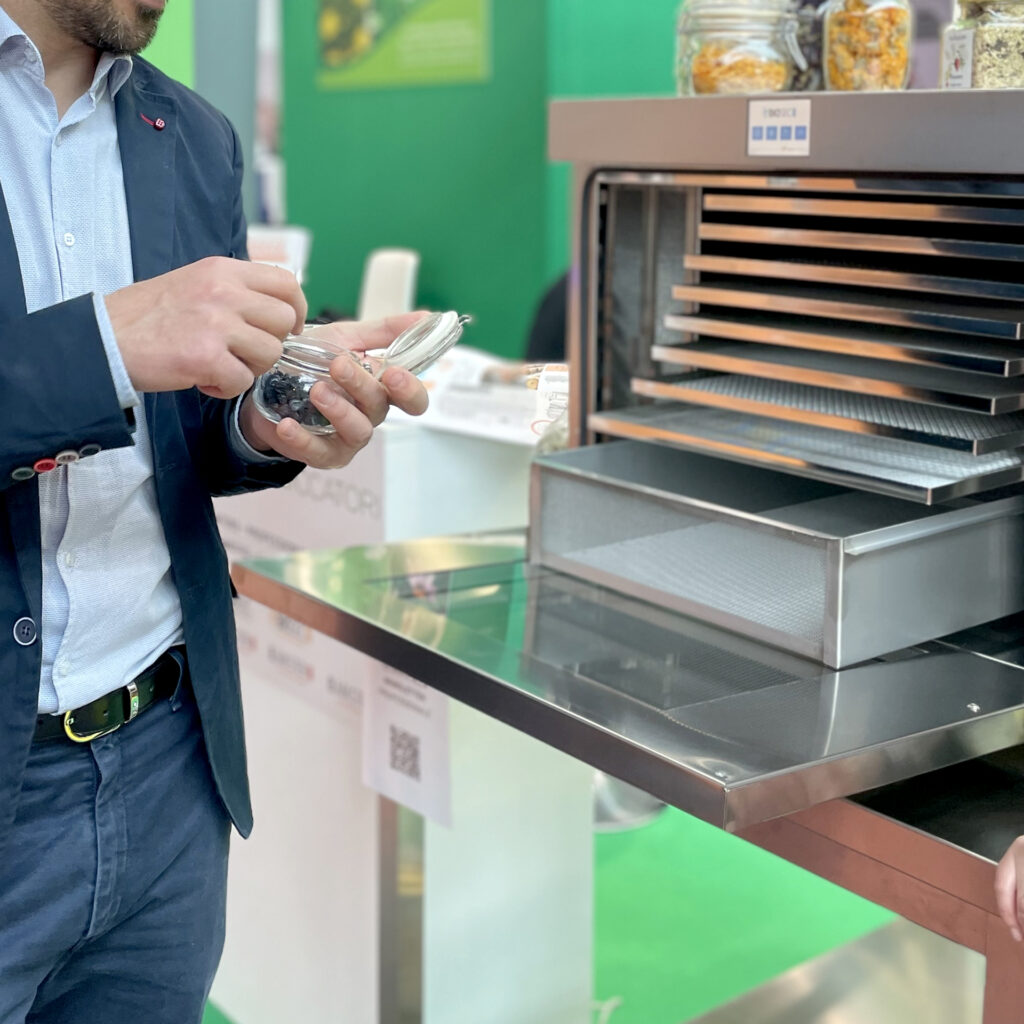
Innovate, experiment, create
Drying is not just a preservation technique, but a real experimental laboratory for the future of food. Universities, research centres, start-ups and secondary institutes are rediscovering its potential to develop new ingredients, reduce waste and make production processes more sustainable.
From dehydration curve mapping to the definition of replicable protocols, drying makes it possible to combine scientific research and practical applications. Students and researchers can observe how humidity, temperature and airflow affect product quality, enhancing fresh raw materials, agricultural by-products and new food varieties.
More and more secondary schools and vocational colleges include drying in their teaching laboratories: a concrete opportunity to bring students closer to food science, experimentation and sustainable innovation.
For whom it is intended
Universities, research laboratories, start-up incubators, technical institutes and secondary schools with agri-food laboratories, companies experimenting with new production models.
The laboratory where science meets nature
Those dedicated to food research and innovation are well aware of the challenge: turning an insight into a replicable, sustainable and raw material-friendly process. Often, the gap between theory and practical application is the ability to preserve integrity of what is being studied. Drying is not just a technique, but a language to decode the future of the agri-food sector, reducing waste and restoring value to each individual resource.
Towards a virtuous cycle: from molecule to market
Experimenting with professional drying means entering a virtuous cycle where nothing is lost. In research labs and start-ups, this technology allows dehydration curves to be mapped with surgical precision. Each test becomes an opportunity to define protocols that guarantee the maintenance of the organoleptic properties and active ingredients, turning surpluses or by-products into new ingredients with high added value.
Scalable innovation for visionary minds
From the university classroom to the first pilot plant, Tauro technology accompanies the evolution of your project. Scalability is at the heart of our vision: enabling those running a start-up or research project to test small batches with the same precision as large industrial plants. This approach guarantees resilience of the business model and the assurance that every step, from prototype to production, is driven by quality and awareness.
Education by doing: training tomorrow's people
Incorporating drying into the educational curricula of secondary schools and vocational colleges means offering concrete tools for hands-on experience of food science. Today's students must learn to manage time and resources ethically. Through the use of desiccators, the student body can observe the physical and chemical transformation of the product, learning that the most authentic innovation is that which respects the rhythms of nature, enhancing agricultural and artisan work.
Find out how to get started
Tauro collaborates with research institutions, universities, start-up incubators and school laboratories, providing professional technology and technical support to turn drying into a applied research and training.
👉 Discover the most suitable professional solutions for your educational institution or start-up
Frequently asked questions
Drying means dehydrate, that is, subtracting from a food its share of water, which is often the bulk of its weight.
In this way, the raw material changes its appearance slightly, but retains - or rather concentrates - its organoleptic and nutritional properties.
Not only that: removing water decomposition and oxidation processes are stopped or drastically slowed down, and the shelf life of the product is greatly extended. from perishable to durable. This greatly simplifies logistics management, storage and sales.
Drying therefore allows preserve food better and longer, preserving its flavour and nutritional qualities.
You can drying and transform:
- fruit
- small fruits
- oily fruit
- aromatic herbs
- medicinal herbs
- flowers
- spices
- saffron
- spirulina
- algae and microalgae
- fungi
- grain
- noodles
- meat
- fish
- brewing treads
- skins and marc
- alternative proteins
You can obtain and commercialise:
- fruit and vegetable chips and snacks
- flavoured powders and salts, flavourings
- spices, herbs and edible flowers
- crispy sheets (leather) of fruit or vegetables
- dehydrated vegetables and soups
- ready meals and preparations for cooking
- energy bars
- fresh pasta
- flours
- infusions
- pet food
Yes, in order to market, sell or administer processed products, it is necessary to operate in a laboratory that is recognised by the health authorities (HACCP), even if it is small or located within the company.
Absolutely. Many facilities start with small quantities to test recipes, snacks or flavour powders before expanding production.
Yes. Drying makes it possible to reduce waste, valorise surpluses and offer natural products with low costs and a concrete economic return.
If you have a farm, drying is an optimal and efficient way to enhance the 100% of your production. You can process products grown by yourself or by third companies with whom you can create network synergies.
You get several benefits, all related:
- zero waste and convert surpluses into a long-term resource
- give a destination to aesthetically imperfect or damaged products by hailstorms or (increasingly frequent) frost, which you would not be able to sell otherwise
- diversify your business and minimise business risk
- increase the catalogue of your offer and distinguish yourself by competitors
- you can sell is directly to the final purchaser, in person and online; but also to retailers such as e-commerce, shops, farms and restaurants.
In general, the advantages of dried products are many.
If you make or trade dried products:
- obtain or resell food with a high shelf life (shelf life)
- greatly simplify the logistical management of your offer, from warehouse to sale
- create a line of healthy products without added sugar or preservatives, of course rich in fibre and nutrients
- conquer a steadily growing slice of the market, which demands healthy, artisanal and ready-to-eat products
Recommended dryers
 Italian
  English
  German
  Spanish
  French
  Romanian